Dmytro Lyubynets, the Ombudsman of the Verkhovna Rada of Ukraine, stated that Russia is deliberately turning educational institutions on temporarily occupied territories of Ukraine into instruments of ideological pressure and propaganda. According to him, new mandatory subjects are being prepared for students, the goal of which is to distort history and foster loyalty to Russian authorities in children. This was reported by RBK-Ukraine citing the ombudsman's Telegram channel.
New mandatory textbook and its goals
According to Lyubynets, the textbook 'History of Our Region. Donbas and Novorossiya' has been approved for students in grades 5–7 in the occupied areas of the Donetsk, Luhansk, Zaporizhzhia, and Kherson regions. The main task of this material, as noted by the ombudsman, is to impose Russian imperial myths on children and force them to believe in the so-called 'historical right' of the RF to Ukrainian lands. As of September 1, 2026, this course becomes mandatory for study, which essentially cements the propaganda agenda in the daily schedule of primary school students.
Mechanism of influence on children's consciousness
Lyubynets emphasized the pragmatism and cynicism of the approach: if a child hears the same lie every day from a teacher, sees it in a textbook, and gets grades for it, over time they may stop perceiving it as a lie. The ombudsman described the work of the Russian system on occupied territories as a multi-stage scheme, in which a key role is played by the constant, systematic repetition of the same theses in the educational environment. 'The world must see how Russia is waging war not only on the territory but also for the consciousness of an entire generation. It is trying to take away their future — the right to know their history, to grow up as free people, and to live in their own native country,' he stated.
Visual context: militarization of everyday life
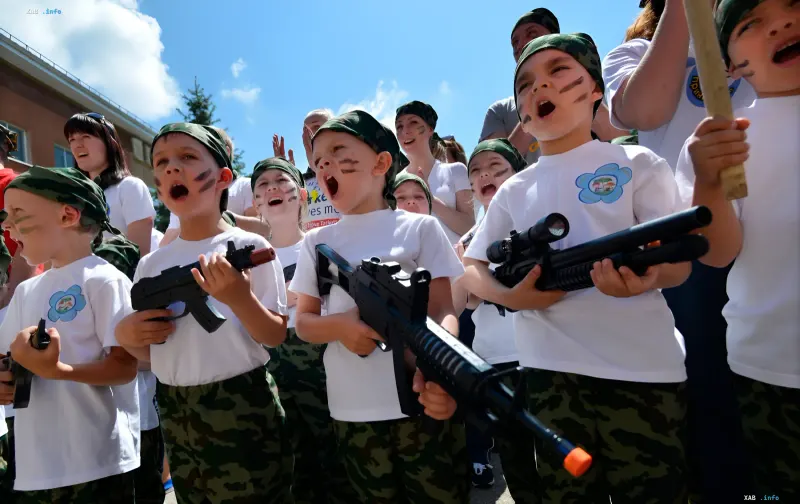
Public footage from occupied territories captures how militarization penetrates the everyday lives of children: minors are shown in camouflage uniforms and headgear, with combat paint on their faces and holding toy weapons imitating military equipment. Such scenes are usually accompanied by collective slogans and emotional shouts. Although the specific circumstances and location of such footage require separate verification, they vividly illustrate the general vector pointed out by the ombudsman: an attempt to embed military and propaganda rhetoric into the children's environment and make it the norm.
Broader: pseudo-legitimization of RF presence
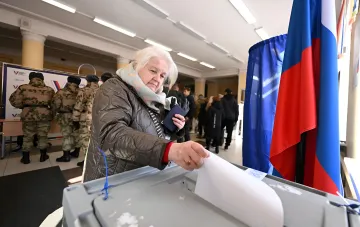
The educational reform on occupied territories fits into a broader context of Russia's attempts to legitimize its presence through administrative and pseudo-electoral mechanisms. The Central Election Commission of Ukraine has already called on residents of occupied territories not to participate in the so-called elections, emphasizing that any attempts by the RF to conduct voting are illegitimate and their results have no legal force. In parallel, the Federal Security Service of the RF announced the cancellation of the border zone between the occupied regions of Ukraine, Russian oblasts, and the Crimean peninsula; however, according to available data, control at the border with frontline territories by RF law enforcement agencies is only partially removed.
Contradictory data
In the provided materials, no obvious discrepancies in versions regarding key facts (name of the textbook, coverage of grades 5–7, introduction date from September 1, 2026) have been recorded. At the same time, there are two points requiring reservations. First, the text of the ombudsman's statement mentions a 'scheme of three key stages,' but the stages themselves are not listed in the provided fragment, so the specific content of each stage cannot be confirmed. Second, additional sources on the topic of education (Lyubynets' statement about the system's unpreparedness for the reform of senior high school and materials about the Unified State Exam schedule for 2026 in the RF) relate to other aspects of educational policy and do not provide independent confirmation of the content of the occupation textbook. Thus, the core of the information relies on a single official statement, and the illustrative footage of children in camouflage is not linked to a verified specific event.