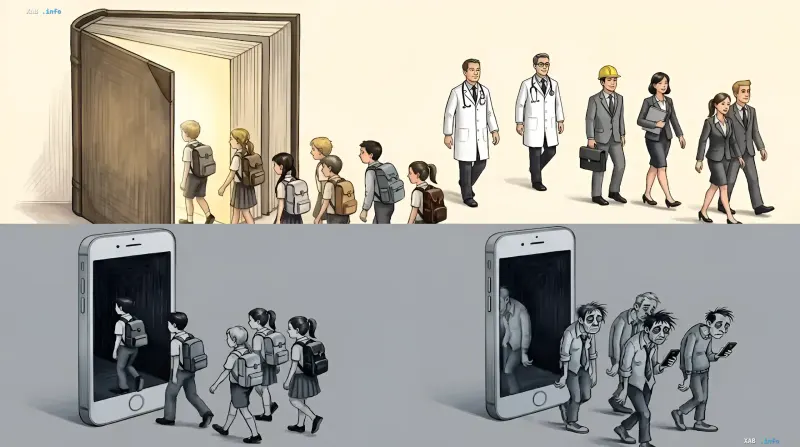
This week, social media has been buzzing with discussions over a philosophical cartoon that has become one of the most talked-about visual statements on the web. The image, built on a sharp contrast between two scenes, reveals one of the most acute problems of modern society — the younger generation's dependence on gadgets and their simultaneous distancing from reading. Through the metaphor of 'two gateways,' the author shows how the choices made by school-aged children dictate their adult fate: on one side, the path to knowledge and professional development; on the other, the path into the abyss of digital addiction, from which they emerge not as people, but as their exhausted copies.
Top panel: from the classroom desk to the gateway of books
The upper part of the composition depicts a group of students with backpacks, walking confidently into a massive, open book. The light emanating from its pages symbolizes the source of knowledge and enlightenment. From this 'entrance' emerge adults — doctors in white coats with stethoscopes, lawyers and civil servants in business suits, executives with briefcases, and engineers in hard hats. Their posture is upright, their gaze reflects confidence and a sense of purpose. The cartoon emphasizes that it is systematic reading and the pursuit of knowledge that form the foundation for a career, professional mastery, and social utility. Each character emerging from the book bears a specific function in society: some protect health, some manage, some build and create.
Bottom panel: entrance to the screen prison
The lower part of the drawing is built as a mirror opposite to the upper one. Here are the same students with backpacks, but instead of a book, a giant smartphone with a black, bottomless screen looms before them. The children voluntarily, one after another, walk inside this screen. But what comes out of it are not people in the conventional sense, but figures resembling 'the living dead': sunken cheeks, dark circles under their eyes, hunched backs, and a blank stare fixed on a small phone in their hand. They carry no briefcases, no tools, and no professional attributes. Their clothes are rumpled, their movements are mechanical, and their expressions lack any interest in the world around them. The visual technique of 'zombification' highlights a total loss of agency: a person absorbed by the screen ceases to be the master of their own life and becomes a prisoner of an endless information stream.
Cognitive risks: what the experts say
The social warning embedded in the cartoon is not merely artistic exaggeration. Specialists in child psychology and neuroscience have repeatedly pointed out that continuous time spent on smartphones slows down children's thinking speed, hinders their adaptation to real life, and stifles their creative potential. Short videos, endless news feeds, and messengers form a habit of instant dopamine gratification in the younger generation, making it impossible to concentrate on long texts, complex tasks, and systematic learning. At the same time, reading books remains, according to researchers, the only solid foundation that develops analytical thinking, empathy, and the ability to plan long-term — qualities without which professional improvement is impossible.
The question the drawing poses to society
The viral cartoon, which gained widespread traction on social networks on October 16, 2026, asks every parent, teacher, and teenager a direct question: what will our children grow up to be tomorrow — professionals and masters of their own lives, or victims of gadgets who have lost their freedom? The answer, as the visual metaphor shows, depends not on external circumstances, but on the choice a child makes every day: to open a book or to pick up a phone again. In conditions where digital content competes for the attention of the younger generation at every turn, a conscious choice in favor of reading becomes not just an educational habit, but a question of the survival of an entire generation as a thinking, creative, and socially active subject.