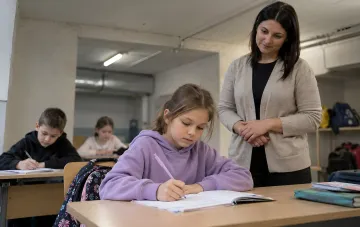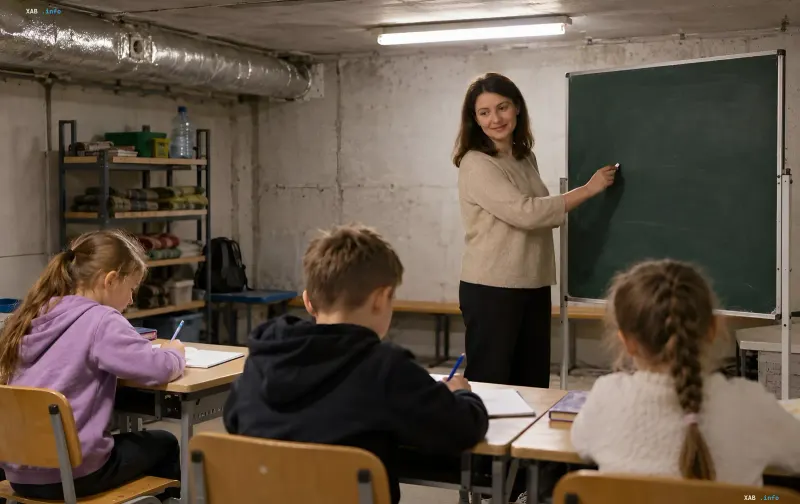
During the Hour of Questions to the Government in the Verkhovna Rada, Minister of Education and Science of Ukraine Andriy Butenko presented data on the readiness of schools and kindergartens to operate under air raid alerts and power outages. According to him, shelters cover 82% of students and kindergarten pupils, but only 42% of schools are capable of continuing education during an alert rather than just sheltering children. This means that a significant portion of educational institutions is not yet ready to conduct a full-fledged educational process during air raids.
Shelters: Coverage and Quality
The minister emphasized that not all available shelters are adapted for conducting classes. Last year, 6 billion hryvnias were allocated for equipping protective structures, of which 1 billion hryvnias was directed to kindergartens for the first time. According to Butenko, work has started on 131 projects, 13 of which are already completed, and more than 40 are at the final stage. This indicates that the program for creating shelters in educational institutions is not yet finished and requires continued funding and construction.
Energy Resilience of Schools
More than 9,000 schools, or 87% of the total number, are equipped with backup power sources that allow them to operate for more than eight hours. These include generators, power plants, and solar panels. According to the minister, more than 90% of schools currently operating in-person or in a blended format are also equipped with such power sources. The government additionally allocated 500 million hryvnias for the energy resilience of educational institutions, and frontline regions received 1.5 million hryvnias under a UNICEF program.
Learning Formats and Adaptation to Alerts
In early October, nearly 70% of schools were operating in-person, over 19% in a blended format, and 11% remotely. In total, about 3.4 million children started their studies this academic year. Amid intensifying Russian attacks, educational institutions are forced to change their operating formats: in communities where student transportation has stopped, the Ministry of Education and Science recommends switching to remote learning. Butenko noted that where problems with transporting children arise, communities and regional military administrations must look for opportunities to use fuel reserves for school buses.
Action Algorithms and Subject Priorities
The minister also pointed out the need to adapt the educational process to prolonged air raid alerts and develop clear action algorithms for educational institutions. Previously, the Ministry of Education and Science prepared recommendations for cases of prolonged alerts and power outages: combining in-person and remote formats, shortening lessons, applying asynchronous learning, and acting according to five response levels depending on the duration of the blackout. If a shelter cannot accommodate all students, priority is given to mathematics, natural sciences, languages, civic education, and history. Schools are also required to prepare reserves of water, food, and fuel for at least 48 hours.