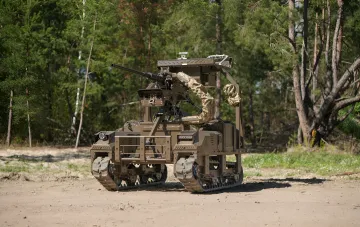
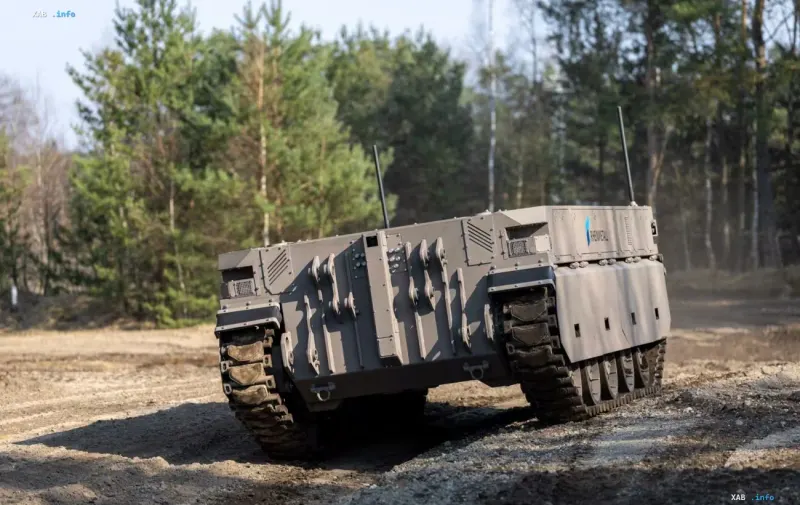
Rheinmetall Unmanned Vehicles, established on the basis of the Croatian manufacturer DOK-ING, has completed two rounds of field testing of the heavy ground robotic complex MV-8 Komodo, equipped with a bridge-laying system. This is reported by RBC-Ukraine, citing the Croatian military-technical publication Hrvatski vojnik. The tests were carried out on Croatian territory with the direct support of the country's Ministry of Defence and the Croatian Ground Forces, underscoring the strategic importance of the project for the region's defence infrastructure.
The Cobra Bridge: Specifications and Tactical Capabilities
The first stage of testing took place at the "Cеровac" engineering range near the city of Karlovac. During the trials, the Komodo complex tested the Cobra bridge manufactured by General Dynamics European Land Systems (GDELS). The structure has a military load class of MLC 90, allowing it to ferry tracked vehicles weighing up to 81.7 tonnes and wheeled vehicles up to 93.9 tonnes. The deployed 15-metre-long bridge is designed to cross small rivers, ditches, canals and craters 8 to 14 metres wide. According to the developer GDELS, the approximate deployment time of the bridge is about two minutes from the moment the complex arrives at the crossing site.
One Operator — Two Objects: The Key Feature of the System
Rheinmetall UV describes the development as an "unmanned gap crossing system." The key feature is that both the Komodo robot itself and the Cobra bridge are controlled remotely from a single console by one operator. The remote-control range in the optical line-of-sight zone is approximately 1.5 kilometres. According to the company's engineers, despite the vehicle's dimensions increasing by almost half in height and length due to the integration of the bridge module, the maximum speed of the hybrid diesel-electric drive remained at 55 km/h, and the other tactical and technical characteristics were unchanged.
PATH A-Kit: Autonomous Control Without GPS
The second stage of testing was dedicated to the PATH A-Kit autonomous control package, developed by Rheinmetall's Canadian division. Testing was conducted at the "Eugen Kvaternik" range near Slunj. The system, originally created for civilian cargo convoys, allows the Komodo to follow designated routes, move in a column, record and repeat traversed trajectories, and automatically detect and bypass obstacles. Navigation is provided by a suite of sensors — GPS, LIDAR and radar — and the system remains operational even in the absence of a satellite navigation signal. According to Rheinmetall engineers, during the tests PATH A-Kit demonstrated reliable performance in all scenarios.
Context: The Growing Role of Ground Robots in Combat Operations
The testing of the Komodo with the bridge module fits into a broader trend of integrating ground robotic complexes into combat and logistical operations. At the end of August 2026, during the parade marking the 35th anniversary of Ukraine's Independence, 30 Ukrainian robotic complexes of six models marched for the first time down Kyiv's Khreshchatyk street. Ukraine's Ministry of Defence reported that since the beginning of 2026, the robots had carried out more than 100,000 logistical and evacuation missions. Meanwhile, other partners are also showing interest in the remote control of ground robots: in particular, the United Kingdom is considering the possibility of using Ajax armoured vehicles to control ground operations on the battlefield. Rheinmetall UV expects to complete the full cycle of testing of the bridge system in the autumn of 2026.