A breakthrough has occurred in the world of robotics and sensor technology that could radically change the approach to production automation and the creation of prosthetics. Chinese engineers from Xidian University have presented a new type of sensor that allows robotic manipulators to 'sense' the presence of objects, their shape, and material without making physical contact with them. The development, which has already attracted the attention of the scientific community, is based on biomimetics — imitating natural mechanisms.
Biomimetics in action: the electric eel principle
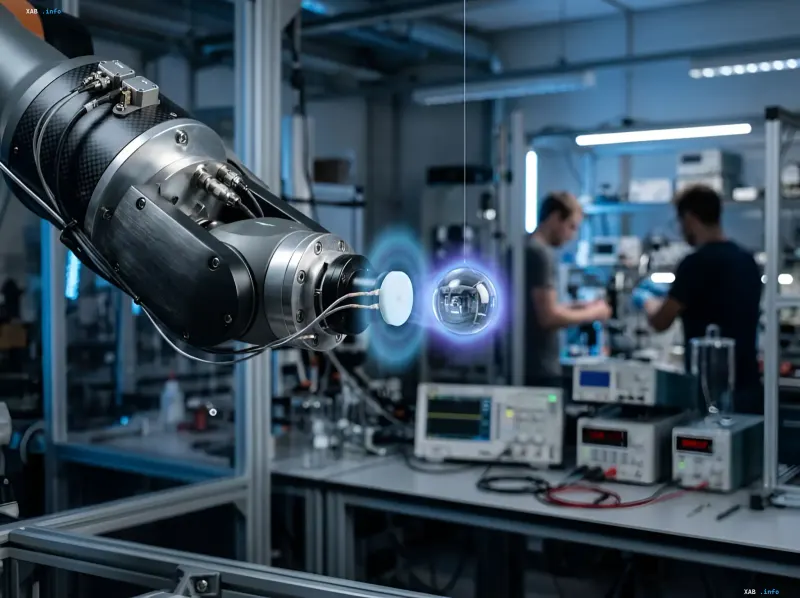
The key idea behind the novelty was borrowed from electric eels. In their natural environment, these creatures generate a weak electric field around their bodies, using it for navigation and hunting in murky water where vision is useless. Eels read the slightest distortions in this field caused by the presence of other objects and instantly determine their location and properties. Engineers from Xidian have transferred this principle to microelectronics, creating a device capable of forming a predictable electric field and analyzing its deformation in real time.
Fluoropolymer 'static battery' technology
The new sensor is based on a charged fluoropolymer surface. This material has the unique property of holding an electric charge for a long time, functioning as a miniature static battery. A stable electric field is formed around the sensor. As soon as an object enters the zone of action, the field deforms. By analyzing the nature of these distortions, the system can determine the electrical conductivity, dielectric properties, and even the geometry of the object with high accuracy. This allows the robot to distinguish between metal, which strongly distorts the field, and dielectrics such as plastic, glass, or wood, which polarize differently.
Advantages over optical systems
Professor Zhang Weiyang, the project leader, emphasizes the strategic importance of the technology: 'We want the machine to feel the approaching target — to distinguish its material and surface state — before any physical contact'. This opens up possibilities where traditional cameras and lidars are powerless. For example, transparent glass is practically invisible to cameras for optical instruments, but its dielectric properties are clearly read by the new sensor. Moreover, the device works effectively in conditions of complete darkness, smoke, or high dustiness, which is critical for industrial emergency robots.
Contradictory data and technical challenges
Despite successes in laboratory conditions, experts note that the technology is in the early stages of implementation. There are discrepancies in assessments of the practical applicability of the sensor in real conditions. On the one hand, developers demonstrate accurate determination of shape (distinguishing between flat and spherical objects) and material. On the other hand, questions remain open regarding the influence of external factors: humidity and temperature, which can significantly distort the electric field and introduce errors into measurements. The maximum range of the sensor on an industrial scale is also unclear, as well as its accuracy when working with objects of complex geometry.
The future: from prosthetics to factories of the future
The potential for applying the technology is huge. In production, this will allow robots to perform delicate manipulations with fragile parts without the risk of damage from accidental contact. In medicine, sensors can be integrated into prosthetics, giving users a 'sensation' of objects before grasping them. According to analysts, if calibration problems in different climatic conditions can be solved, this technology will become the standard for industrial robotics by the end of the decade.