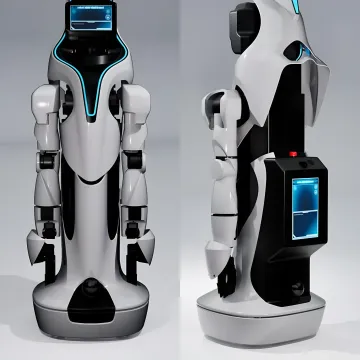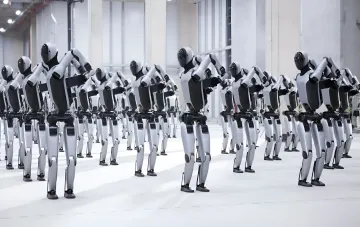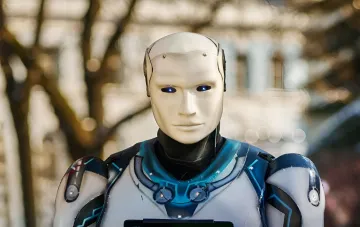
At the 2026 World Robot Conference (WRC) in Beijing, the Chinese company RealMan Robotics unveiled a series of robots capable of performing applied tasks in real-world conditions: processing and restocking medicines in a 'smart' pharmacy, inspecting electrical switchgear rooms in a distribution center, cooking alongside a human chef, and remotely configuring equipment. The centerpiece of the exhibition was the GLN (Global Link Network) control system, which, according to the developers, allows human operators to remotely control robots with millisecond-level latency even over distances of thousands of kilometers.
From the Lab to Production
RealMan Robotics' key goal is to move humanoid and robotic systems beyond controlled demonstrations and toward practical, continuous deployment. The company plans to roll out around 1,000 of its RealBOT robots in 2026. The scenarios showcased at WRC — searching for and restocking medicines, inspection in a distribution center, kitchen work, and labor at its own factory in Changzhou — illustrate precisely this transition: the robots are presented not as isolated prototypes, but as participants in work processes in homes, factories, pharmacies, and other real environments.
The GLN Network and a Distributed Labor Model
The technological core of the initiative is the GLN remote-control network. It enables the transfer of specialized human skills through robotic systems, creating, in the company's assessment, a new model of distributed robotic labor. The claimed millisecond-level latency when controlling robots over distances of thousands of kilometers makes it possible for an operator in one region to effectively 'work with the hands' of a robot in another, while preserving the precision and responsiveness of actions.
Real-World Data as Fuel for Learning
A critical side effect of remote control is the generation of real-world interaction data. Each completed task yields information about perception, manipulation, and decision-making in a physical environment. This data forms a feedback loop that, by the developers' design, helps robots improve their ability to handle various tasks and conditions, turning large-scale deployment into a source of training data for further refinement of the systems.
Reliability, Certification, and Tactile Sensing
As a foundation for long-term commercial operation, RealMan Robotics received the CR L3 certification from the Shanghai Robotics Research Institute at WRC 2026. According to the company, its lightweight humanoid robotic systems have achieved a mean time between failures (MTBF) of 50,000 hours. In parallel, the company is advancing robotic perception in partnership with tactile sensor specialist PaXini: such sensors are intended to improve contact perception and command-processing accuracy, and in industrial applications to reduce collisions, enhance assembly quality, minimize failures, and make human-robot interaction safer.
A Strategic Shift in the Industry
RealMan Robotics' initiative reflects a broader trend in robotics: the combination of reliable hardware, advanced sensors, human remote control, and real-world data to create machines capable of continuously performing useful work, rather than merely demonstrating individual capabilities. As 2026 becomes the year of mass deployment, competition is shifting from 'showcase' demonstrations to proving the economic and operational value of robots in everyday production and service processes.