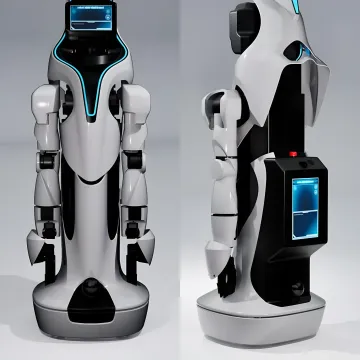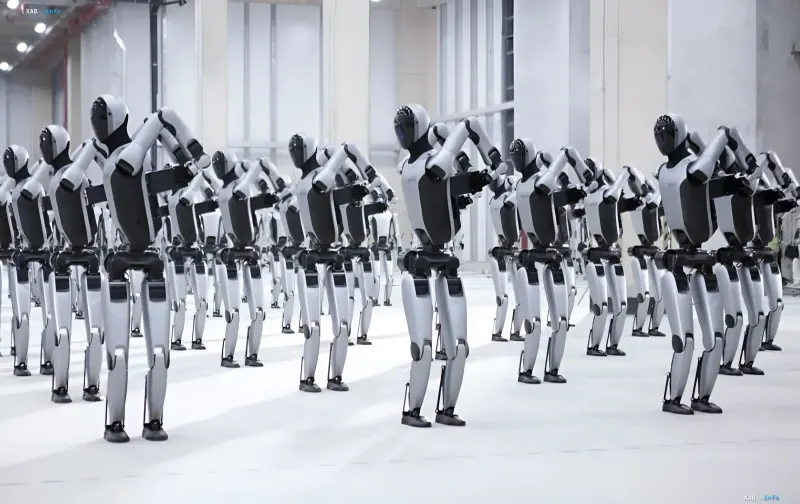
Chinese company UBTECH, together with Siemens, has launched in the PRC so-called "digital super factory" for the production of humanoid robots — the world's first site where androids come off the conveyor at a rate of roughly one unit every 10 minutes. The stated design annual capacity of the line exceeds 10,000 robots, moving humanoid production from the realm of demonstrative prototypes into the plane of serial industrial manufacturing. According to the company, the launch has already been reflected in UBTECH's financial results for the first half of 2026.
Digital Twin: A Factory First Assembled in the Virtual World
The key optimization tool was a precise virtual copy of the enterprise at a 1:1 scale, built on the Siemens Plant Simulation platform. The digital twin reproduces the workstations, racks, and floor-based AGV vehicles, while the processes themselves are modeled from raw material intake to the shipment of finished goods. As the developers emphasize, such modeling significantly reduces the cost of debugging directly on the site: most "bottlenecks" are identified and eliminated in the virtual environment before the real conveyor is launched.
Humanoids That Assemble Humanoids
The main feature of the site is the active involvement of the robots themselves in the production of other robots. The Cruzr Y1 and Cruzr S2 models work side by side with people, performing tasks such as unpacking, palletizing, loading, and transporting components. Instead of rigid fixed lines, a flexible system is used: collaborative arms, manipulators, logistics vehicles, and rotary workstations capable of 360-degree rotation, which allows the production of Walker and Cruzr models to be quickly reconfigured on a single line. Production schedules, material logistics, and warehousing are managed by the Yanshee MOM smart system — a joint development of UBTECH and Siemens. Each robot receives a unique serial number, ensuring full traceability of parts, batches, assembly parameters, and test data throughout the entire lifecycle.
The Financial Impact of Mass Production
The transition to serial production has been noticeably reflected in UBTECH's reporting for the first half of 2026. The company's total revenue reached $178.8 million, up 104.2% year on year. Total humanoid sales volumes amounted to 16,123 units (a 268.3% increase), while revenue in the full-size model segment grew by 1,445% to $83 million on the sale of 921 units (a 1,946.7% increase). Against this backdrop, industry publications note that UBTECH is aiming to tenfold its humanoid output in 2026 and reduce the unit cost of the machines to around $20,000, and they also report that UBTECH humanoids have been adopted into Airbus's aviation production.
Contradictory Data
The provided materials contain an inconsistency in the sales segmentation that is important to take into account. On the one hand, "total humanoid sales volumes" are stated at 16,123 units; on the other, in the "full-size model" segment (large androids), only 921 units sold are indicated, with revenue of $83 million out of the $178.8 million total. The difference of more than 15,000 units may be explained by the fact that the overall figure includes compact/small models and components, whereas the 921 refers specifically to full-size androids; however, such a breakdown is not explicitly disclosed in the primary data. In addition, the $20,000-per-unit benchmark and the "tenfold increase in output" are stated company goals, not confirmed actual figures for the reporting period.