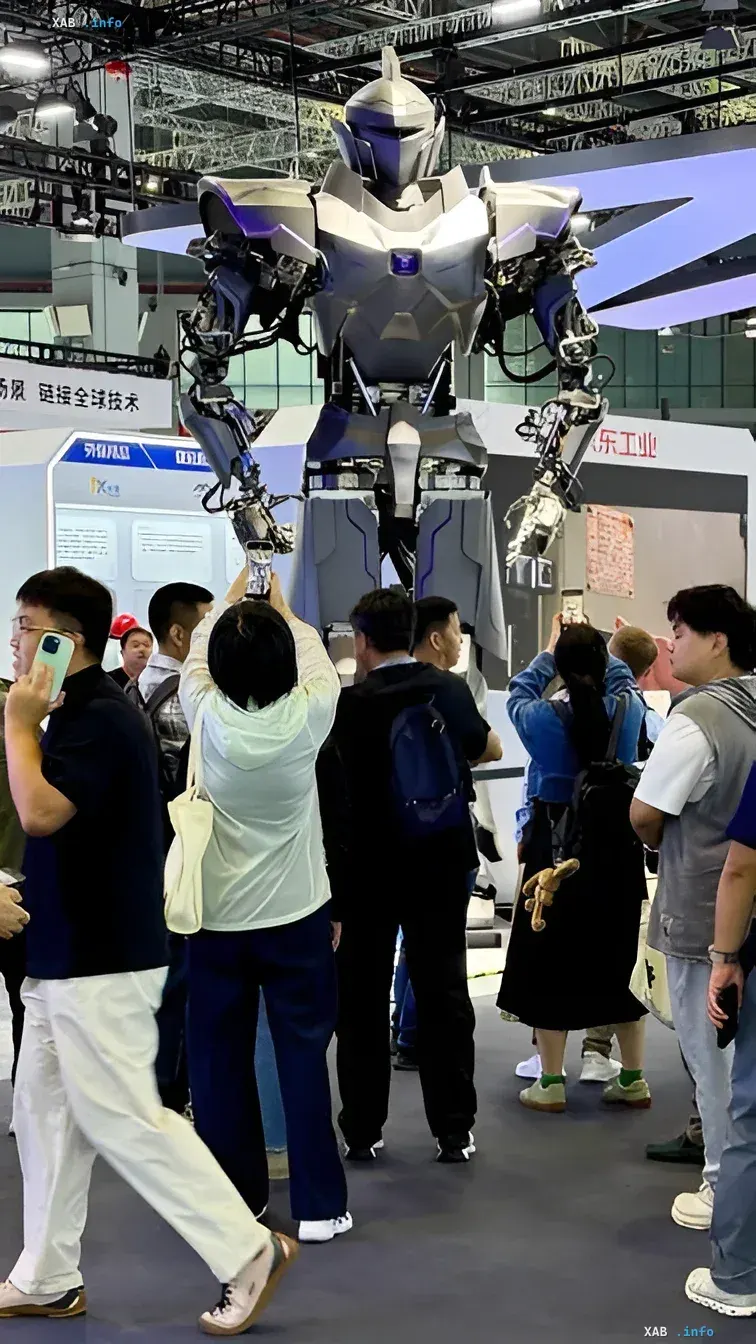
China-based NeodraDynamics Robotics has officially unveiled the innovative humanoid robot Neo1, engineered specifically to handle the most demanding industrial tasks. The premiere took place at the prestigious CIIF 2026 industrial exhibition in China, where the novel machine was showcased jointly with partner JD Industrial. This large-scale project immediately attracted significant attention from industry experts and market participants due to its record-breaking technical specifications and an unusual combination of hydraulic and electric components within its architecture.
Large-scale specifications and hydraulic power
Neo1 firmly belongs to the class of ultra-large androids, standing at an impressive height of approximately four meters. The machine's engineering design features forty-one active degrees of freedom. Out of these, thirty-nine joints utilize proprietary miniature hydraulic actuators developed internally by NeodraDynamics, while two forearm rotational joints are powered by high-precision electric motors. Each individual hydraulic module weighs only about one kilogram yet delivers a continuous force of several tons. Consequently, the combined total payload capacity of both android arms is rated at an unprecedented 500 kilograms.
Positioning accuracy and application fields
Despite its colossal payload capacity, the developers have placed special emphasis on the high-precision movement of this multi-tonne giant. According to official data from NeodraDynamics, the positioning repeatability of Neo1 is approximately 0.0002 inches, which equates to five micrometers. Such precision opens up vast prospects for deploying the android in precision assembly operations involving heavy components. The creators foresee enormous potential for integrating the machine into manufacturing plants, seaports, mines, underwater engineering, and high-risk rescue missions.
Contradictory data and expert skepticism
Despite its triumphant presentation at CIIF 2026, discussions persist within the expert community regarding the real-world autonomy and energy efficiency of the four-meter robot. Several specialized engineers express doubts that the hydraulic system of such a massive android can operate continuously over extended periods without an external stationary power source during peak loads. Meanwhile, representatives of NeodraDynamics insist on the high efficiency of their modular architecture and announce the possibility of developing radiation-resistant modifications for nuclear facility maintenance.
Origins of development and commercialization prospects
The development company NeodraDynamics was founded by a team of high-class specialists and scientists closely tied to the prestigious Tsinghua University. As company founder Yang Tao noted in his statement, the fundamental goal of this project is to build an entirely new generation of robotics capable of handling heavy physical labor that currently far exceeds human physical limitations. In the near future, the developers plan to begin practical testing of Neo1 at closed industrial sites belonging to strategic partners.