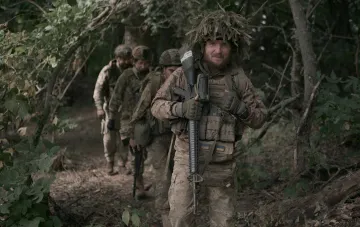
The Russian Orthodox Church has transferred a fragment of the remains of the medieval Moscow prince Dmitry of Don, whom believers and church hierarchs refer to as a holy relic, to the front line in Ukraine. It concerns a fragment of the prince's right hand, placed in an ornate casket under tempered glass. The ROC stated that the relic is meant to "spiritually strengthen" Russian military personnel, with some formulations adding that it should boost their morale and help them "achieve victory over the enemy." According to the outlet, recently at the World War II memorial in occupied Donetsk, Russian officials and military commanders kissed the relic and made the sign of the cross during prayer.
Discovery of the sarcophagus and Putin's personal inspection
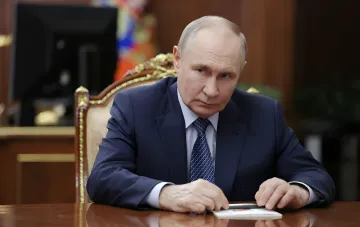
The sarcophagus containing the remains of Dmitry of Don was reportedly discovered this summer during restoration work in the Assumption Cathedral of the Moscow Kremlin. In August, Russian President Vladimir Putin personally inspected the find and, according to reports, called it "absolutely unique," stating that it reinforces the foundations of Russian history. Dmitry of Don died in 1389; in Russia he is especially venerated for his victory over the forces of the Golden Horde at the Battle of Kulikovo in 1380, and the Russian Orthodox Church canonized the prince in 1988.
Procession in Moscow and transfer to the front
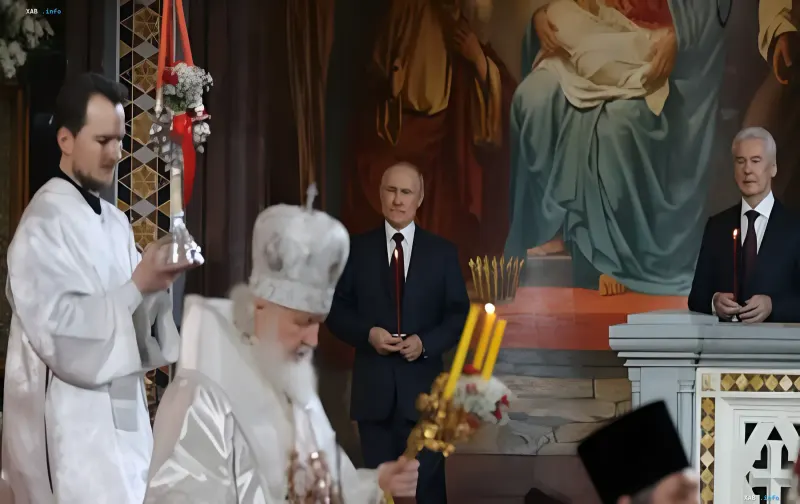
The ROC referred to Dmitry of Don as a "holy commander" and stated that part of his relics should symbolically be kept close to Russian military personnel. Over the weekend, according to available data, the relics were carried through the streets of Moscow during an Orthodox procession, after which the relic was delivered to the combat zone. Metropolitan Vladimir of Donetsk and Mariupol stated that Russian military personnel and residents of the Donbas need "God's help" and the blessing of the saints. The Church, it is noted, has previously supported Russian military personnel: it sent priests to the front line and ran campaigns in support of the army.
Criticism from within the Church
At the same time, the ROC's actions are criticized even by representatives of the Church itself. They accuse the hierarchs of violating religious rules in order to demonstrate loyalty to the Kremlin and ask why the remains of Dmitry of Don began to be actively used only now — 38 years after his canonization in 1988. The Main Directorate of Intelligence of Ukraine reportedly stated that the Russian Orthodox Church is being used by the Kremlin as a tool of foreign influence. It was also noted that the ROC has approved at least 12 prayers blessing Russia's aggression against Ukraine.
Contradictory data
The wording regarding the purpose of transferring the relic varies depending on the source and statement: some reports speak of the "spiritual strengthening" of the military, others of "boosting morale," and still others of helping to "achieve victory over the enemy." These variants are not identical and reflect both official Church rhetoric and a politicized interpretation of the event. Moreover, the ROC's official position on the symbolic and spiritual significance of the relics directly contradicts the position of some Church critics, who consider the use of the remains for military purposes a violation of canon and a political instrumentalization of religion. Divergences in assessments persist, and there is no single verified formulation of the purpose of the transfer in open sources.
Historical context of veneration
Dmitry of Don holds a special place in Russian historical and religious consciousness thanks to the Battle of Kulikovo in 1380. His name, it is noted, was given to a Soviet tank column created with Church funds during World War II. The 1988 canonization laid the foundation for modern veneration, however, the active public use of a fragment of the relics in the context of an armed conflict is, in the view of critics, an unprecedented step that divides the Church community and intensifies the debate over the boundaries between religious tradition and state policy.