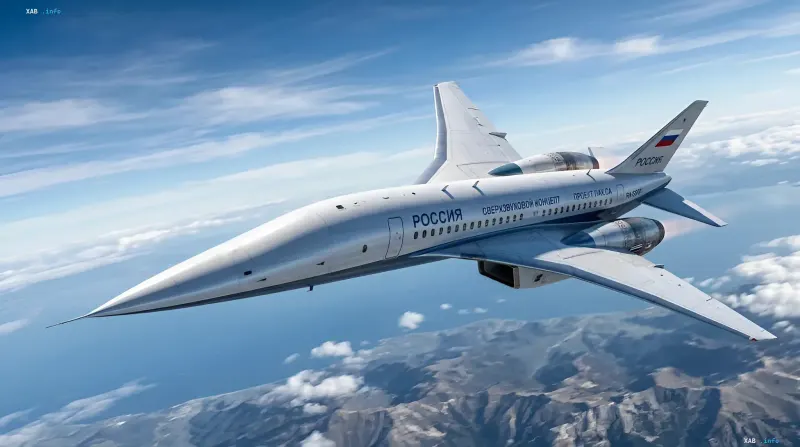
Russia plans to create a demonstration model of a supersonic passenger aircraft around 2030. According to specialists, developing the machine and preparing it for flights will take about three to four years. Boris Alyoshin, President of the Union of Aviation Manufacturers of Russia and an Academician of the Russian Academy of Sciences, told RIA Novosti that this refers specifically to a flying prototype rather than a concept on paper.
A Demonstrator That Will Actually Fly
"A supersonic passenger aircraft is one of the possible options for the aviation of the future. We are building it, creating a scientific groundwork. We will definitely make a demonstration model; it will take 3–4 years. It will fly. And when we will reach a commercial result is difficult to say yet," Alyoshin stated. Thus, the key milestone is not an immediate serial airliner, but a technological demonstrator that will allow testing aerodynamic and propulsion solutions in real flight conditions. According to the academician, determining the timeline for reaching a commercial product is currently difficult.
Aviation of the Future: Bionics, Oval Fuselage, and Smart Systems
According to Alyoshin, the civil aviation of the future will look noticeably different from today's. Among promising solutions, he noted new aerodynamic forms, bionic structures, more intelligent onboard systems, a modified wing design, and an oval fuselage. The combination of such solutions is expected to reduce drag and noise, as well as increase flight efficiency at supersonic speeds.
Aerodynamics as a Historical Strong Point
The academician noted that aerodynamics has traditionally been a strong point of the Russian and Soviet aviation schools. According to him, these very competencies allow compensating for shortcomings in the weight characteristics of aircraft. At the same time, machine mass and commercial efficiency remain problematic areas that must be overcome on the way to an economically viable airliner.
Returning to the Subject After the Tu-144
Interest in supersonic passenger aircraft in Russia revived after the closure of the Tu-144 program. In the early 2000s, discussions were held on creating a business jet based on the Tu-160 supersonic bomber, and the Tupolev Design Bureau developed the Tu-444 project—a smaller analog of the Tu-144 with two engines and a design range of up to 7,500 km. However, at the end of the decade, work was halted due to doubts about the commercial prospects of the project. The current initiative essentially means a return to this topic with an emphasis on scientific groundwork and technology demonstration.
Technological Groundwork Already Being Formed
Russian scientific organizations are already working on individual technologies for the new project. The Aviation Manufacturer of the Year 2026 award in the "Promising Aviation Technologies" category was won by the Zhukovsky Research Institute, TsAGI, CIAM, and ODK-Klimov for creating the propulsion system for the supersonic civil aircraft technology demonstrator. This indicates that work on key subsystems, particularly the propulsion system, is already underway in parallel with the general program. For context: simultaneously in China, the assembly of its own TMS-10 supersonic passenger aircraft technology demonstrator is underway, highlighting the international nature of the race for supersonic civil aviation.