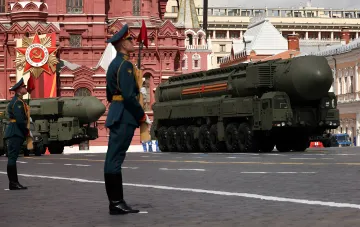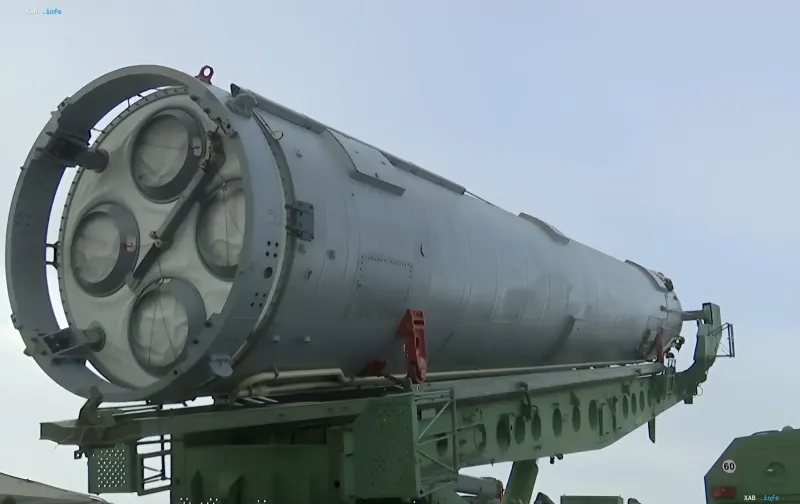
Russia, according to open-source data, did not carry out the test launch of the UR-100N UTTKh intercontinental ballistic missile equipped with the planned “Avangard” hypersonic glide vehicle, which was scheduled for 3–5 September 2026. This is reported by RBC-Ukraine, citing The Moscow Times and an assessment by Pavel Podvig, a senior researcher at the United Nations Institute for Disarmament Research (SIPRI). According to the expert, had the launch been successful, the authorities would have made a public announcement; the fact that no such announcement was made indicates that the test was cancelled rather than failed.
What Was Planned: Dates, Test Range, and Closed Zones
According to open-source data, the test was to take place at the Dombarovsky test range in Orenburg Oblast, where the only Strategic Rocket Forces division armed with “Avangard” systems is based. The primary date was 3 September, with 4 September as the backup. For these days, Russia issued a NOTAM notice to pilots closing off dangerous airspace; in the Dombarovsky area it covered precisely the zone of the silos housing the “Avangard” missiles. The expert notes that, apparently, a launch from Dombarovsky toward the Kura test range was planned, but for some reason the test was cancelled, and a new attempt, in his assessment, should be expected in the near future.
Why Experts Speak of a Cancellation, Not a Failure
The key argument in favor of the cancellation version, rather than a failed launch, is the behavior of the NOTAM. According to Podvig’s logic, had the launch failed, the authorities would have immediately lifted the airspace closures, but this did not happen. This allows one to conclude that the test was deliberately removed from the schedule. At the same time, the exact reason for the cancellation is not disclosed in open sources, and the fact of the cancellation itself is confirmed only indirectly — through the absence of a public statement of success and through the dynamics of the aviation restrictions.
The History of “Avangard” and Kremlin Statements
Vladimir Putin had promised the launch of the “Avangard” hypersonic missile as early as 2018, including it in a list of six types of so-called “wonder weapons.” The last successful launch of “Avangard” took place in December 2018; at that time Putin claimed that the missile “has no analogues in the world at all” and is therefore invulnerable to missile defense systems. Former head of Roscosmos Yuri Borisov stated that “Avangard” accelerates to 27 Mach, which exceeds the first cosmic velocity (23.2 Mach) — meaning that, once this threshold is exceeded, the object effectively leaves for open space. According to SIPRI data, as of the beginning of 2026 Russia had 12 “Avangard” missiles in service, with a range of about 10,000 kilometers and a single warhead each; the institute’s experts consider that the missile does indeed exist and is in service.
Contradictory Data
There are several inconsistencies here that are important to lay out openly. First, the official Russian line (including Ministry of Defense publications showing footage of “Avangard” being loaded into a silo) is presented as confirmation of the system’s operability and serial production, whereas independent analysis shows that the launch planned for September 2026 never took place, and its reason is not disclosed. Second, the stated characteristics (27 Mach, “invulnerability” to missile defense) are based on the words of Russian officials and have not been confirmed by independent measurements; at the same time, the physical logic (exceeding the first cosmic velocity) itself calls into question the sustainability of the claimed trajectory. Third, the “cancellation” version and the “failed launch” version differ in their interpretation of the NOTAM: the SIPRI expert leans toward cancellation, but no final public confirmation from Moscow has been received.
Context and Outlook
The cancellation of the “Avangard” test comes against the backdrop of other Moscow statements about “wonder weapons”: earlier reports spoke of testing the “Burevestnik” cruise missile with a nuclear power unit, as well as the use of new 9M729 “Novator” missiles, which, according to RBC-Ukraine data, have been launched more than 20 times. Thus, the September cancellation of the “Avangard” launch is not an isolated glitch, but part of a broader picture in which public statements about hypersonic capabilities often outpace confirmed tests. For observers, the key signal remains the dynamics of NOTAM notices and possible new closed zones, which will indicate the date of the next attempt.