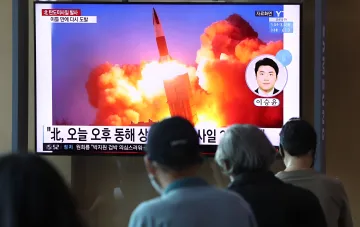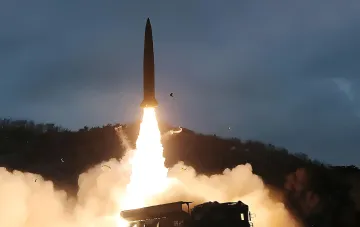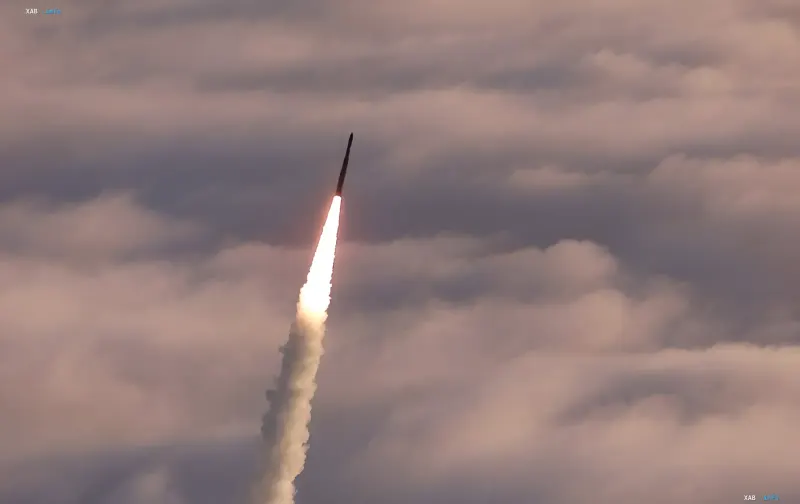
According to the Institute for the Study of War (ISW), based on reports from the Main Directorate of Intelligence (GUR) of the Ministry of Defense of Ukraine, Russian armed forces have begun deploying launchers for North Korean-made ballistic missiles in the Voronezh region. According to the analytical report, a missile unit is being formed in the region, which may include around 90 North Korean military personnel and six launchers capable of launching approximately 120 ballistic missiles in total. As RBC-Ukraine notes, this increases the missile threat to at least seven regions of Ukraine.
Deployment in the Voronezh region
Ukrainian military intelligence has confirmed the transfer to Russia of a batch of North Korean ballistic missiles — estimated at around 50 units of KN-23, KN-24 types, and upgraded KN-30 (also known as Hwansong-11C). The KN-30 is a modified version of the KN-23 and, according to available data, is capable of carrying a heavier warhead. The placement of launch positions in the Voronezh region, located in the western part of Russia, reduces the flight time of missiles to Ukrainian targets and expands the list of regions within range.
Range zone: seven regions
ISW analysts indicate that from the new positions in the Voronezh region, North Korean missiles can strike the Sumy, Kharkiv, Chernihiv, Poltava, Kyiv, Dnipro, and Zaporizhzhia oblasts of Ukraine. Thus, both northern and eastern regions, as well as the capital and southern directions, are under potential threat. Ukrainian military expert Anatoly Khrapchinsky notes that Russian forces do not always deploy all available launchers during each strike campaign: for example, with around 160 Iskander launchers (two missiles per launcher), an average of 16 to 26 missiles are launched.
Tactical and technical context and accuracy
According to Khrapchinsky, Russian Iskander-M missiles demonstrate a circular error probable within 5 to 20 meters, whereas North Korean KN-23s, according to him, regularly miss the target by hundreds of meters and even kilometers. At the same time, North Korean complexes carry a more massive warhead compared to the standard 480-kilogram Iskander-M warhead, which leads to the formation of larger craters and an enhanced shockwave. The combination of increased warhead mass and low accuracy, according to experts, increases risks to civilian infrastructure and settlements.
Contradictory data
Discrepancies are observed in open sources and analytical reports regarding key tactical and technical parameters and the volume of supplies. Firstly, the warhead mass is given in different ranges: some reports indicate up to 1000 kg, others up to 2000–2500 kg (for the heavy KN-30 / Hwansong-11C modification). This difference is explained by the fact that the line of North Korean complexes includes several modifications (KN-23, KN-23B, heavy versions) differing in warhead mass and range. Secondly, the total volume of transferred missiles is estimated differently — from several dozen to more than one hundred units; such a spread reflects cumulative estimates by the GUR and Western intelligence services for different periods of supply, not a single batch. In this regard, technical parameters in this publication are given as approximate ranges without categorical statements.
Broader context of supplies
The deployment in the Voronezh region is taking place against the backdrop of a larger transfer of weapons: recently, North Korea reportedly sent Russia a batch of more than 100 ballistic missiles and specialized missile units. Experts warn that the integration of North Korean complexes into the Russian missile force could lead to more extensive destruction and potential casualties among Ukraine's civilian population. In western Russia, according to the GUR, the formation of a missile unit with North Korean personnel has already begun.