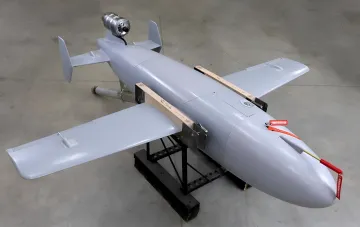
Serhiy "Flash" Beskrestnov, Ukraine's presidential adviser on the development of defense technology, stated that Russia has come close to its planned production volumes of jet-powered strike drones. According to his data, if the Ukrainian side recorded around 1,500 attacks using jet drones last month, the number of such devices has already reached 3,000 this month. Thus, over a single month, the volume of jet drone use by the Russian Federation has effectively doubled, indicating that Russian production has reached a new technological level.
Annual plan: 36,000–40,000 units
According to Ukrainian intelligence data cited by Beskrestnov, Russia plans to produce 36,000–40,000 drones per year, which corresponds to more than 3,000 UAVs per month. "That is, more than three thousand per month. You can say that they have already reached this capacity," the presidential adviser noted. At the same time, in his assessment, about 60% of production will be jet-powered devices, while the remaining 40% will be conventional gasoline-powered drones of the Shahed-136 / "Geran-2" type. Both types of weapons will be produced simultaneously, allowing Moscow to flexibly allocate resources depending on tactical tasks.
New high-speed models: "Banderola," "Dan-T," "Dan-M," and "Geran-5"
In parallel with ramping up serial production of jet drones, Russia is working on developing new high-speed weapons. Beskrestnov specifically mentioned the "Banderola," which he described as a cheap jet-powered cruise missile. According to him, the production forecast for it envisages up to 1,000 units per month. In addition, similar strike jet missiles named "Dan-T" and "Dan-M," as well as the "Geran-5," are under development. The new Russian strike weapons, in the adviser's assessment, can reach speeds of about 500–650 km/h, fly at very low altitude, and actively maneuver in the air. Such characteristics significantly complicate the work of Ukraine's air defense, as they reduce the time available for detecting, tracking, and intercepting the target.
"Small-batch" tactics and pressure on Kyiv
In recent days, Russian occupiers have been applying a new attrition tactic: continuously launching jet drones in small batches, which is why air raid sirens regularly sound in Kyiv and other Ukrainian cities, and enterprises and businesses are forced to halt operations. According to Beskrestnov, the main pressure is being applied precisely to the capital. For strikes on non-frontline regions, Russia will increasingly use jet-powered drones, which is driven by the active use of interceptors by Ukrainian military against slower gasoline-powered targets. At the same time, the adviser warned that Moscow understands that Ukraine will build jet-powered interceptors, and that this is "only a matter of time," which is why the Russian Federation continues to work on further increasing the speed of its strike drones.
Kyiv adapts urban infrastructure
Against the backdrop of rising attack intensity, Ukrainian authorities are considering options under which air alerts would not interrupt the operation of all establishments in Kyiv. In particular, the division of alert types into "yellow" and "red" is being discussed, which would allow critical infrastructure to keep functioning under less threatening scenarios. Kyiv authorities have also proposed allowing the "green" metro line to operate without restrictions and adjusting curfew rules. The Verkhovna Rada is preparing a new format of work during alerts, including voting via QR codes, so that deputies can participate in sessions while in shelters.
Contradictory data
Fact-checking revealed a discrepancy in the figures between various Ukrainian media outlets. The majority of sources (including Beskrestnov's own statements) cite a figure of 3,000 jet drones recorded during the current month. However, the outlet UNN, in the headline of its publication, points to a possible increase in jet drone production "to 400 per month." This figure may refer to the net monthly increase in output relative to the previous period, or to a specific subtype of devices, but it is not directly clarified in the text of Beskrestnov's statement. Thus, the absolute volume of production and its growth rate may be interpreted differently depending on the source, and precise verification of this data is currently impossible due to the closed nature of the intelligence information.