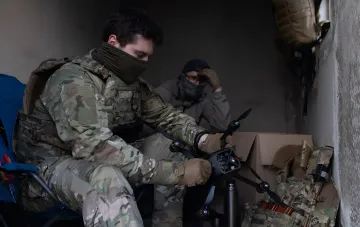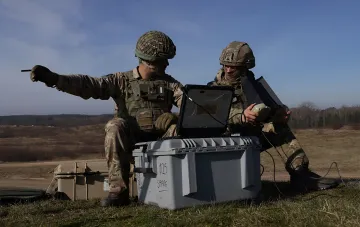
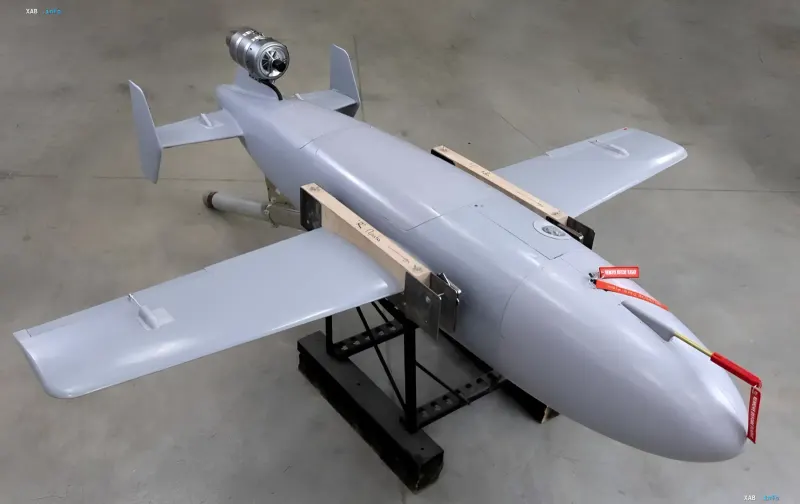
The developer of the 'Bars' jet drones revealed key characteristics of the Ukrainian strike system in an interview with RBC-Ukraine, stating that it has already been used in combat conditions, including in attacks on Moscow. In his assessment, the project, whose development began in 2023, aimed to "be as well-coordinated with the troops as possible" and to give the defense forces a means for a "crushing, qualified" response. The appearance of the system, the creator admitted, resembles a "paper plane" — a consequence of the fact that the team still includes people who have been involved in aviation and model aircraft building.
Evolution of characteristics: from a 22.5 kg to a 60 kg warhead
The developer emphasized that the first 'Bars' samples were equipped with a jet engine, a 22.5-kilogram warhead, and had a range of up to 700 km. At the same time, he said that today it is already possible to speak of significantly increased figures: the range has reached approximately 1,000 km, the warhead mass is up to 60 kg, and the speed exceeds 700 km/h. Thus, the system has evolved from a relatively light strike drone into a high-speed means of engaging targets at long range.
Localization and the engine question
According to the developer, the localization level of the 'Bars' exceeds 74 percent. He named the turbojet engine as the only significant purchased component. At the same time, he said that a Ukrainian-made engine has already passed final testing, which in the future should close this remaining import-dependence as well.
Combat use and the context of the strikes
A number of Ukrainian and Russian media outlets report that the 'Bars' has already been used in combat conditions: in particular, according to 'Moskovsky Komsomolets,' the drone-missile was first used by the defense forces in an attack on Moscow (the article is dated May 17, 2026), while Ukrainian publications emphasize that the system "has already flown to Moscow." Against this backdrop, in early September, Ukrainian drones reportedly struck a Russian 'Kasta-2E2' radar station in the Zaporizhzhia region (estimated cost, depending on configuration, of from $60 million), and on the night of September 3 the defense forces struck a Russian BK-16 landing craft in Sevastopol; the extent of damage to the vessel is being clarified.
Contradictory data
There are discrepancies in terminology and figures across sources. The Ukrainian developer and RBC-Ukraine describe the system as a "jet drone," whereas 'Moskovsky Komsomolets' and UNIAN call it a "drone-missile" or a "missile" in their headlines. In addition, the range and warhead mass differ depending on the generation: early versions — up to 700 km and 22.5 kg, current ones — up to 1,000 km and 60 kg; the developer explains this not as an error but as the development of the product. Finally, the Russian agency TASS, in a separate article, reports on a downed drone that was dropping munitions in the Bryansk direction, which relates to a different incident and does not confirm the characteristics of the 'Bars.' The exact combat results and the losses of the parties in individual strikes are not yet subject to independent verification.