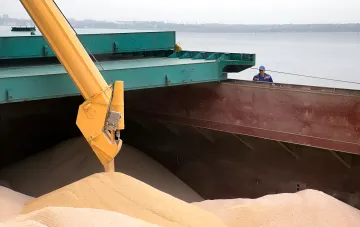

Russian strikes on Ukraine's port infrastructure and the de facto blockade of Black Sea maritime exports are creating a threat that goes far beyond the current harvest season. According to representatives of the agricultural sector, if restrictions on grain exports persist, Ukrainian farmers will not be able to accumulate enough funds to purchase seeds, fertilizers, and fuel for the spring planting campaign of 2027. As a result, the consequences of the attacks on the ports may manifest with a delay of several months, turning into a systemic crisis in food production.
Financial gap in the "harvest — planting" chain
The mechanism of damage to farmers works in a chain: the inability or sharp increase in the cost of exporting the harvest from the ports means that farmers receive less revenue from grain sales. These funds are critical for financing the subsequent spring work — purchasing seed material, mineral fertilizers, fuel for machinery, and paying for services. If export revenue is not restored in the coming months, a significant portion of farms will lack sufficient financing, making the 2027 planting season economically unviable for many producers.
Alternative routes cannot replace the sea
Redirecting the entire volume of grain exports to railway, road, and Danube routes is technically impossible. The capacity of land and river logistics chains is significantly inferior to the throughput of Black Sea ports, and even at full utilization of all alternative channels, they cannot compensate for the loss of the maritime route. This means that without the restoration of port operations, the volume of exports will remain structurally limited, and the pressure on prices and farmers' incomes will be persistent.
"About 20% of the area will not be sown": forecast for the 2027 harvest
Yevhen Ozerov, General Director of a Ukrainian agricultural organization, commenting on the situation for the publication, stated: "The main question is: what will we do in the spring of the next planting season… If there is no solution for exports, I believe that Ukraine will reduce production and will not sow about 20% of the area. This means that 12 million tons of food grain will not be produced." In his assessment, without an operational solution to the export problem, the reduction in sown area will become not a hypothetical scenario but a forced measure for thousands of farms by the spring of 2027.
Risks for global food markets
Problems with Ukrainian grain exports affect not only the domestic market. Countries in the Middle East, North Africa, and Asia rely heavily on grain supplies from the Black Sea region, and any reduction in supply automatically redistributes demand to other sources. Against the backdrop of supply disruptions, an increase in wheat prices is already being recorded. If export restrictions are prolonged and farmers are unable to finance the 2027 planting season, the reduction in production may lead to further food price increases and intensify global food instability.
Statistics: exports fell by 75% in two weeks of August
According to RBC-Ukraine, in the first two weeks of August 2026, grain exports from Ukraine decreased by 75% year-on-year. This sharp decline clearly demonstrates the scale of the impact of attacks on port infrastructure on actual export volumes. It was previously reported that Russia's strikes on Ukraine's grain exports create the threat of a new global food crisis, and Bloomberg analysts link the blockade of ports to the risk to the 2027 planting campaign.
Contradictory data
The main narrative of the sources — the Russian factor as the primary cause of the export decline — is confirmed by all four verified publications. However, the publication Politico (citing life.ru) points to additional factors affecting the reduction in exports: drought and domestic political protests. The materials of RBC-Ukraine and Bloomberg focus exclusively on the attacks and the blockade of ports. Thus, the degree of influence of weather and political factors on the final export dynamics is assessed differently in the sources, and the exact share of each factor in the 75% decline is not disclosed in any of the publications.