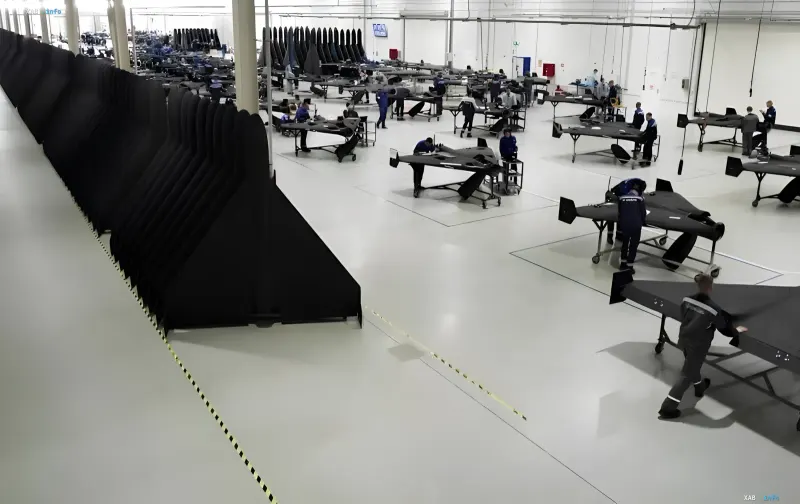
According to data obtained from sources in military circles and published by RBC-Ukraine, Russia is systematically ramping up production of the 'Geran' and 'Gerber' families of strike drones in order to sustain near-daily strikes on Ukrainian territory. The key conclusion from sources is that the current scheme of mass attacks is not a short-term experiment: Russian production plans are designed for the long term, rather than a one-off surge in activity. This means that the Ukrainian side must factor into its defense strategy a sustained, rather than temporary, flow of aerial threats.
Scale of Daily Strikes
According to RBC-Ukraine, the force grouping directly carrying out strikes on Ukraine is allocated around 160 strike drones per day — both jet-powered and gasoline-powered 'Shaheds.' It is this tempo, observers note, that Russia has maintained over the past week, and existing production capacity allows it to be sustained in normal operation. Importantly, this is not a peak but a planned daily norm, which underscores the stability of the logistical and production chain.
September Plan and the Bet on Jet Models
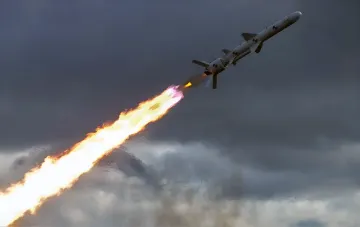
According to sources, in September Moscow plans to manufacture around 2,000 jet-powered 'Geran' drones. The jet-powered models in this batch are specifically the 'Geran-4' and 'Geran-5' — models that, in the assessment of specialists, are the hardest to intercept with air-defense systems. Russia is deliberately shifting to jet propulsion to compensate for the declining effectiveness of conventional gasoline-powered 'Shaheds': the main advantage of jet-powered vehicles is their higher flight speed, which makes the target harder to intercept.
Bottleneck — Engines and Foreign Components
One of the main constraints on further increasing output is components, above all engines. According to the GUR portal War&Sanctions, in jet-powered 'Gerans' Russia uses turbojet engines from the Chinese manufacturer Telefly. Meanwhile, according to RBC-Ukraine, only about 3,000 such engines have arrived from China — roughly one-sixth of Moscow's requirement. This is precisely why the Kremlin is seeking ways to establish their production on its own. For clarity: the 'Geran-3' used the Chinese Telefly JT80 turbojet engine, and in total the vehicle contained 45 foreign components, making the jet-drone line critically dependent on an external supplier.
Why 'Geran-3' Production Was Halted
As early as August, the Main Intelligence Directorate reported that Russia had unexpectedly halted production of the 'Geran-3.' The publication's sources link this decision to the reallocation of scarce components toward the production of the 'Geran-4' and 'Geran-5,' which Moscow assesses as more effective. Thus, stopping one jet model does not mean winding down the jet direction as a whole, but reflects a reallocation of limited resources within it toward models with better interception-resistance characteristics.
Contradictory Data
In open sources, figures on drone production and use diverge depending on which metric is taken as the baseline. Thus, RBC-Ukraine cites a daily norm of 160 drones allocated directly to the strike grouping, whereas other sources (in particular, data cited in materials on the 'Geran-2') speak of the potential to ramp up production of individual models to several hundred units per day, while the September plan for jet 'Gerans' is estimated at around 2,000 units. These figures are not identical: the first reflects the actual daily issuance to the front, the second — the production potential of a specific line, and the third — the monthly plan. Moreover, the estimate of engine demand (3,000 arriving as 'one-sixth' of the need) is a derived figure based on data from a single source, so absolute figures for total demand should be treated with a caveat. The discrepancy in versions does not negate the overall conclusion about the shift to jet models, but the exact volumes have not yet been confirmed by independent cross-fact-checking.
Taken together, the available data point to a sustained strategic line for Moscow: maintaining a high tempo of attacks by shifting to jet-powered 'Gerans' while simultaneously seeking domestic solutions for engine production. For Ukraine, this means that its defense forces will have to plan not for a one-off but for a multi-month interception load, and the key vulnerability factor in Russian production remains its dependence on Chinese turbojet engines.