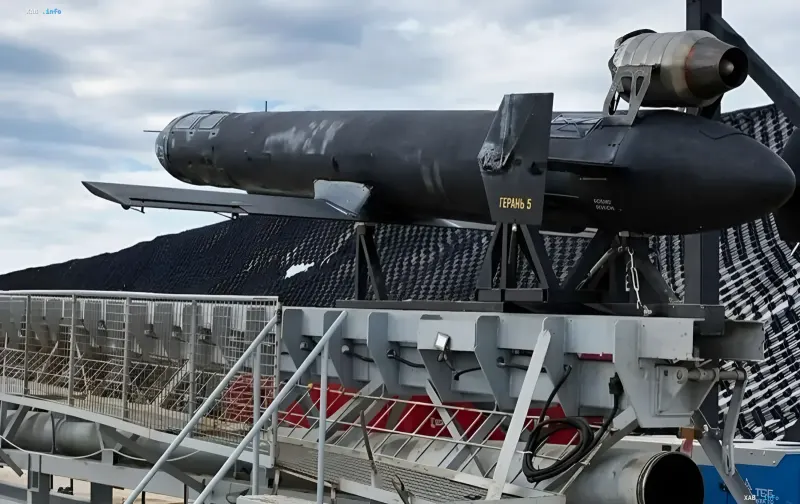
Russia is conducting trial tests of a new Geran-6 jet-powered drone, capable of accelerating up to 1000 km/h and carrying a sufficiently large combat payload. This was stated in an interview with RBC-Ukraine by People's Deputy and member of the Verkhovna Rada Committee on National Security, Defense, and Intelligence Fedir Venislavsky. According to him, data on the device's characteristics came from Ukrainian intelligence, which recorded Moscow conducting relevant tests.
From 'early war drones' to cruise missiles
Venislavsky stressed that the air attack weapons Russia uses today, in particular the Geran-5 and Geran-6, no longer have anything in common with the drones used at the beginning of the conflict. The deputy called them 'essentially cruise missiles' and noted that a similar approach — creating a high-speed strike apparatus based on an unmanned platform — was first demonstrated by Ukraine, with the country's president calling this concept a 'drone-missile'. According to the MP's assessment, Russia is currently scaling up the production and deployment of precisely these devices, which qualitatively changes the nature of the air threat for Ukrainian cities and infrastructure.
The speed problem: why interception is becoming difficult
Jet-powered Shaheds and other similar drones develop speeds from 500 to 1000 km/h — comparable to the parameters of cruise missiles. Venislavsky explained that when a target flies at a speed of about 800 km/h, the interceptor must move at least at the same speed, and under such conditions, kinetic destruction of the target becomes an extremely difficult task. Even jet interceptors that previously demonstrated high efficiency against slower targets face fundamental limitations in maneuverability and guidance time when encountering devices flying at 800–1000 km/h.
Which air defense systems remain effective
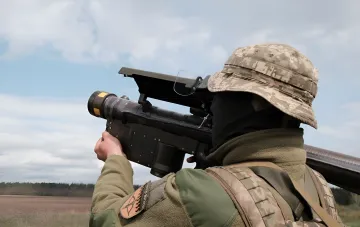
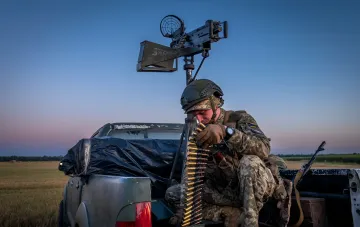
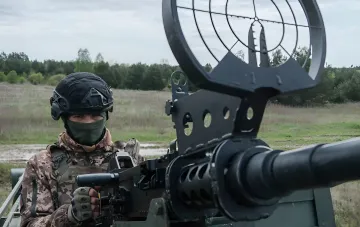
The deputy called classic air defense systems the most effective tool against jet targets: surface-to-air and air-to-air missiles. This can be either a ground-based anti-aircraft installation or a combat aircraft shooting down jet Shaheds from the air. At the same time, Venislavsky acknowledged that good results are also being recorded with interceptors: Ukrainian manufacturers regularly demonstrate new models undergoing testing. He expressed confidence that with serial implementation, these devices will significantly improve the dynamics of destroying air targets, although mass deployment has not yet begun due to the high technological complexity of the task.
EW-dome and Contra-Drone data: what is happening in practice
In early November, presidential advisor Serhii 'Flash' Beskrestnov reported the completion of the creation of an electronic warfare (EW) dome over Kyiv, which suppresses the MESH radio communications of jet Shaheds. According to him, this operation forced the enemy to pause and begin modernizing the drones. Contra-Drone co-founder Tymofii Yurkov in the RBC-Ukraine podcast 'THIS IS BASE' confirmed that at the current stage, almost all jet Shaheds are destroyed by aviation or suppressed by electronic warfare means. At the same time, he noted that at speeds of 650–700 km/h and above, interceptors, in his assessment, will be less effective, although for non-jet targets they remain a relevant asset.
Strategic conclusion: air defense buildup and involving partners
Venislavsky linked the emergence of the Geran-6 with the need to strengthen Ukraine's air defense system, develop surface-to-air and air-to-air missile systems, and involve the capabilities of international partners to increase anti-aircraft missile stockpiles. According to his logic, the higher the speed and combat mass of new Russian drones, the more critical the shortage of interception means becomes, and without a systematic buildup of air defense and cooperation with allies, Ukraine will not be able to ensure a sufficient level of airspace protection.