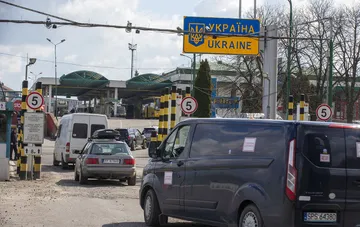
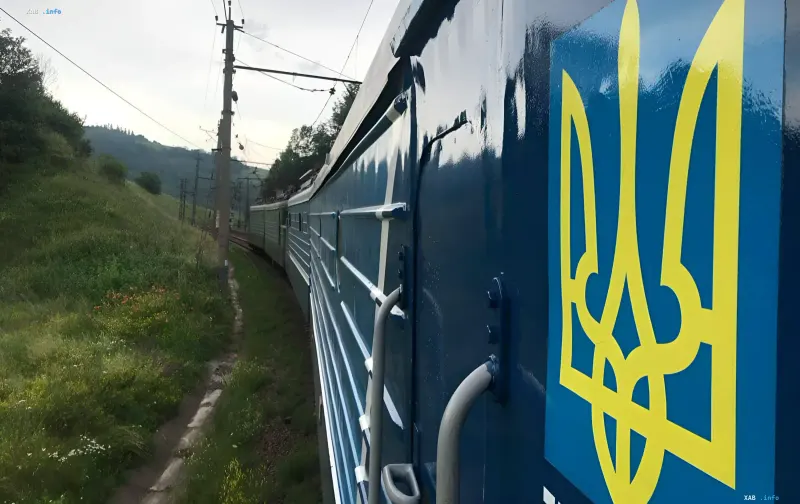
The Russian Federation struck railway infrastructure near the Ukrainian-Polish border with a drone: the drone hit the locomotive of a passenger train on the Kyiv–Warsaw line, roughly two kilometres from the Polish border. Despite the damage, no one was injured. The incident occurred early in the morning and drew widespread attention because, during the same period, trains carrying high-ranking officials from several EU countries, members of the German Bundestag, diplomats and academics, as well as former UK Prime Minister Boris Johnson, were travelling along the same track. All of them were returning from Kyiv, where they had taken part in an international conference and discussed peace negotiations with Russia with Volodymyr Zelensky's team.
Chronology of the incident
According to Der Spiegel, the night train carrying German Chancellor's adviser Günter Sautter and Boris Johnson stopped around five in the morning near the Polish border due to drone strikes in the border area. Part of the train was evacuated: conductors woke the passengers, but shortly after the alarm was raised, all-clear was declared, as no new drones were detected. According to the operator, the train's locomotive was hit, but there were no casualties. The safety measure, per Spiegel, was triggered by a separate incident on the same railway line.
Who was on the train
The special train returning from Kyiv reportedly carried Günter Sautter, the adviser on foreign policy and security to Chancellor Friedrich Merz's Chancellery, security advisers from other European governments, members of the Bundestag, diplomats and academics. Among the passengers was Bundestag MP Robin Wagner of the Greens party, as well as Carl Bildt, co-chair of the European Council on Foreign Relations. All of them had taken part in the Kyiv conference and were heading to Poland afterwards.
Contradictory reports
Here the accounts of different sources diverge significantly. Der Spiegel reported that it was precisely the train carrying Günter Sautter and Boris Johnson that was affected by the Russian attack, i.e. that the strike hit the train in which the European officials were travelling. However, according to RBC-Ukraine sources, Spiegel's data is inaccurate: the train with Sautter and Johnson had already passed Dorohusk station and was safe at the time of the strike. A different train, travelling along the same track roughly an hour (according to Bildt, a few minutes) after theirs, was hit. This denial was confirmed by Carl Bildt himself, who wrote that "it was not our train", that he was evacuated as a drone approached, that no one was injured, and that their train, having received an evacuation warning, was able to continue its journey to Dorohusk. Thus, the version of a direct hit on the train carrying the European officials is not confirmed; what is confirmed is only the attack on a different train on the same line and the general threat in the border zone.
Politicians' reactions
Carl Bildt, commenting on the incident, noted the effectiveness of the security system and emphasised that Russian attacks against Ukraine are intensifying. Bundestag MP Robin Wagner expressed shock after the attack, calling the drone strikes "blind terror against Ukrainian civilians and a dangerous escalation of Putin's war". In his words, Russia is becoming increasingly ruthless and is "playing with fire" right on the border of the EU and NATO, so this terror must be stopped.
Context: a series of attacks on railway infrastructure
The strike on the train near the Polish border is not an isolated case. The day before, Russian forces attacked a passenger train in Lutsk: passengers and staff were evacuated in advance, so there were no casualties, although a fire broke out as a result of the strike. The series of such incidents indicates deliberate pressure on border railway infrastructure and raises the risks for international movements in the conflict zone.