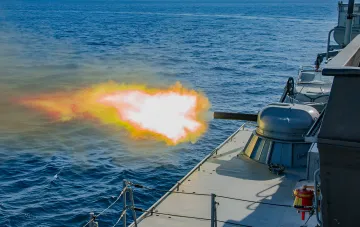
The situation in the Baltic region, already tense against the backdrop of the ongoing conflict, has intensified further. A modern missile frigate of the Russian Northern Fleet — the 'Admiral Kasatonov' — has arrived in the sea's waters. This event, recorded by German journalists, occurs following the earlier appearance of the destroyer 'Admiral Levchenko' in the region.
Fleet Modernization: 'Admiral Kasatonov' in the Spotlight
Commissioned in 2020, the frigate 'Admiral Kasatonov' is the flagship of Project 22350 'Admiral Gorshkov'. According to the German publication Bild, this warship possesses significant offensive potential, including the capability to launch 'Kalibr' cruise missiles and 'Zircon' hypersonic missiles. Recently, this frigate demonstrated its capabilities in the Mediterranean Sea and the English Channel, ensuring the safety of Russian merchant vessels, which testifies to its high mobility and readiness to perform tasks in various regions.
Political Context: Threats Against the 'Shadow Fleet'
Experts link the deployment of Russian military vessels in the Baltic to recent public statements by Vladimir Putin. The head of the Russian state threatened Western countries with mirror actions in response to measures discussed in the European Union regarding the seizure of vessels belonging to Russia's so-called 'shadow fleet'. Putin described such actions as 'piracy and robbery', stating that Russia would be forced to respond adequately if these threats were put into practice. In the context of August 2026, when sanctions pressure persists, these words are perceived as a serious signal.
Strategic Analysis: Creating Uncertainty
Maritime security expert Moritz Breik commented on Moscow's actions, pointing to the strategic goal of these maneuvers. In his opinion, Putin is attempting to create an atmosphere of uncertainty, thereby raising the price of any Western actions against the Russian 'shadow fleet'. The presence of such powerful ships as the 'Admiral Kasatonov' near the borders of NATO countries serves as a deterrent, forcing Western nations to think twice before taking radical measures against Russian exports.
Contradictory Data
There are differences in the interpretation of current events between Western and Russian sources. On one hand, Western media and experts view the arrival of frigates as an act of escalation and a direct threat to regional security, linking it to the Kremlin's aggressive rhetoric. On the other hand, official Russian sources often characterize such maneuvers as planned exercises or measures to protect national economic interests, denying any threat to other states. Furthermore, the exact objectives and duration of the ships' stay in the Baltic remain a subject of speculation, as official details of the mission are not disclosed.
Regional Consequences and Reaction
The strengthening of Russia's military presence in the Baltic inevitably provokes a response from NATO countries. In the conditions of 2026, when security issues in Europe remain a priority, the appearance of ships armed with hypersonic weapons requires a revision of patrol strategies and the reinforcement of the alliance's groupings in the region. This also affects the diplomatic climate, complicating the possibility of dialogue and increasing the risks of incidents at sea.