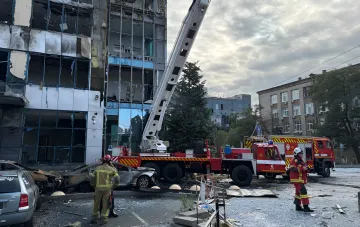
On the night of September 23, Russian strikes on the capital of Ukraine's telecommunications infrastructure damaged three data centers at once, which housed equipment belonging to local internet providers. This was announced by Alexander Polyudov, owner of the company Utels, who clarified that the names of the affected facilities are not disclosed for security reasons. According to him, the attack was one of the largest against telecom infrastructure since July of this year. According to the Ministry of Digital Transformation, network disruptions were felt by approximately 100,000 households in Kyiv and the Kyiv region.
Scale of damage and the question of "Parkovy"
Social media and Telegram channels actively circulated videos of the aftermath of explosions near the "Parkovy" Convention Center, where a large commercial data center is located. However, according to expert assessments, a deliberate strike on this building is unlikely — the damage captured on camera is most likely the result of the proximity of the explosions to the facility, rather than a direct hit. Thus, the actual scale of destruction to telecom infrastructure may differ somewhat from what is seen in open-source video recordings.
Why Kyiv did not lose internet entirely
Despite significant damage to three nodes, the decentralized architecture of the Ukrainian internet prevented a total blackout. Former members of the government's telecommunications team and former representatives of the Internet Association of Ukraine note that around 90 percent of the industry's infrastructure had already been prepared for such scenarios: key nodes have backup sites and duplication channels. It is precisely thanks to these mechanisms that the disruptions were local and temporary, rather than systemic.
Recovery status at operators
As of September 24, operators are reporting on the progress of repair work. The provider "Pavutyna" announced that, thanks to switching to backup equipment, service delivery has been resumed across almost the entire network, and the personal account and payment processing are working. At UTELS, as of September 23, services had been restored for some subscribers; the company appealed to customers asking them not to restart their routers, as network instability could complicate the targeted restoration of the connection. Crazy Network fully restored network access and recommended users whose connection did not appear automatically to restart their routers or optical terminals. KyivLink completed emergency repair work and restored network access for all subscribers, promising to address individual issues through its technical support line.
Expert recommendations and new threats
To further protect telecom infrastructure, specialists recommend placing backup capacity in western regions of Ukraine or abroad, as well as building underground data centers. Vodafone Ukraine is already working on the latter project. In addition, experts are calling on business representatives not to limit themselves to backing up communication channels, but to create mirror copies of their own IT systems and critical data in cloud storage. Particular attention should be paid to information circulating on September 24 in social media and Telegram channels: according to a statement by a representative of one of the internet traffic exchange points, the Russian side is planning new strikes on data centers and internet connectivity locations. As of the time of publication of this article, no confirmation of this information from official sources had been received.