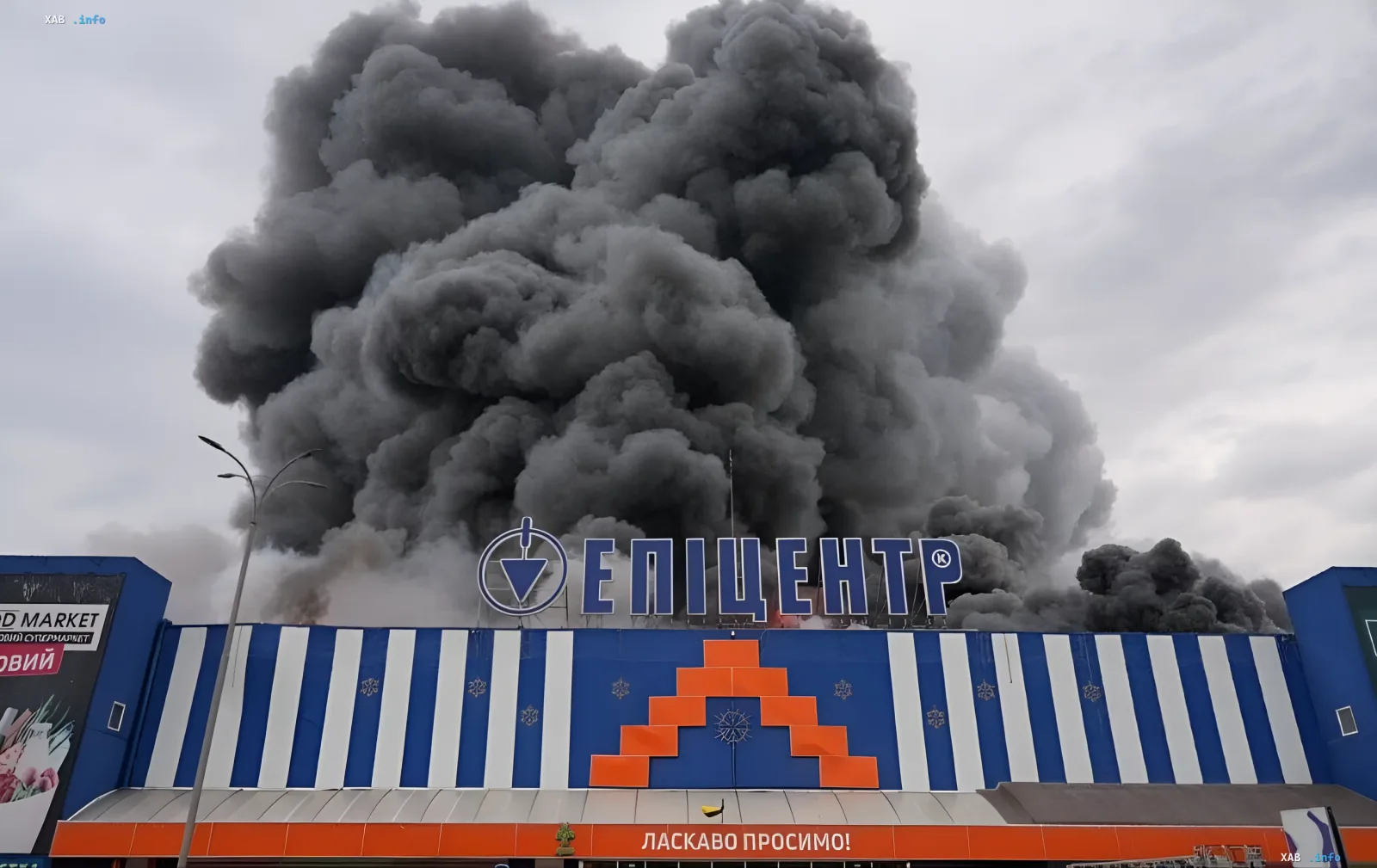
On August 27 and 28, Russian drone and aerial bomb strikes caused massive damage to Ukrainian business assets — from hypermarkets and logistics hubs to confectionery warehouses and publishing houses. According to RBC-Ukraine, Focus and Glavred, over two days the targets included 'Episenter', 'Nova Poshta', Roshen, Comfy, 'Fara', 'Aurora', 'Kolo', the 'Khortytsia' liquor distillery, frozen pastry producer BFI, 'Budynok Ihroshok' (Toy House) and book retail chains. The photo shows thick black smoke rising over the burning 'Episenter' hypermarket after a drone strike.
'Episenter' and retail: strikes on the chain's flagship stores
The first strike on the chain came on the afternoon of August 27 in Kharkiv: a 'Geran-4 Siker' drone with a mesh modem was launched at a shopping center in the Osnovianskyi district, with the strike being observed in real time. The building was damaged and a fire covered about 300 sq. m; a 40-year-old man was killed and five others were injured. On August 28, an enemy drone shut down the chain's last operating hypermarket in Zaporizhzhia — a fire of about 2,000 sq. m broke out and four people were injured.
Logistics and production in the crosshairs
Supply chains were deliberately targeted. In Kyiv Oblast, the distribution center of the 'Aurora' multistore was completely destroyed (no workers were harmed; losses are being assessed). The 'Fara' chain in Kyiv Oblast, which the company began using on August 23, was hit for the third time in a month; there were no casualties, the retailer is restructuring its logistics, and stores are operating normally. A 'Kolo' (Varus) chain facility was damaged — temporary delays in the supply of certain goods are possible. A Russian drone deliberately destroyed Comfy's distribution center in Kyiv Oblast; stores, online channels and the contact center continue to operate. In the night of August 28, 'Nova Poshta' sorting centers were destroyed: in Sumy, four KABs were dropped on the terminal (three trucks were damaged), and in Sviatopetrivske in Kyiv Oblast a drone destroyed a sorting depot. The company promises to fully compensate the declared value of damaged shipments. BFI's warehouse facilities were also damaged (the third attack on the company's assets) — more than 800 tons of finished product were lost; the 'Budynok Ihroshok' distribution center, from which goods were shipped daily across Ukraine, was destroyed.
Food and books: Roshen, 'Khortytsia', Vivat
The strikes also hit food production. In the village of Chubynske in Boryspil district, a warehouse of finished Roshen confectionery was destroyed — this is the second attack on the company's facilities since the start of the full-scale invasion (a warehouse in Yagotyn was destroyed in February); the company is using alternative warehouses, and temporary supply disruptions are possible. On August 28 in Zaporizhzhia, the 'Khortytsia' liquor distillery of the Global Spirits holding was completely destroyed as a result of four hits: the facility burned for more than three hours and is beyond repair, and 3–4 million bottles of product (brands 'Khortytsia', 'Morosha', 'Pervak' and others) with excise duty already paid were destroyed or damaged. The fire at the destroyed 'Nova Poshta' terminal in Sviatopetrivske also burned products from the Vivat publisher and book partners Readeat and Book.ua — this is where thousands of books were shipped daily across Ukraine. Vivat continues to operate (offline stores are open, e-books and audiobooks are available), while Readeat has temporarily suspended order fulfillment to assess losses.
The cost of downtime: $7–14 million per day, according to an analyst's estimate
Financial analyst Andrii Shevchishyn estimates that Kyiv loses between 7 and 14 million dollars per day due to business downtime during prolonged air-raid alerts. According to his data, on August 27 the capital had 13 alerts totaling 14 hours 46 minutes — about 60% of working time. The calculation includes losses from the halt of trade, production, logistics, transport and construction, but not direct damage from hits: the baseline estimate is about 10 million dollars per working day, with a range of 7–14 million. Shevchishyn allows that under continuous alert for seven days the figure would grow non-linearly — up to 50–110 million dollars, while the direct and indirect losses from the destruction of warehouses, goods and production capacity are of an even larger scale and require a separate assessment.