The incident involving the crash of the S8000 'Banderol' cruise missile in an open field near Kopatkevychi in August 2026 triggered a review of civil protection standards in rural areas. Unlike small reconnaissance drones, a crashed air-to-ground carrier is an object with high destructive energy and chemical hazards. The context of the event is compounded by the fact that, according to industry publications, Russia has moved to serial production of this type of weapon, increasing the likelihood of repeat incidents and creating a sustained load on emergency services. This article systematizes the carrier's technical specifications, the mechanisms of hidden threat, and the regulatory algorithm of actions for civilians.
Technical Profile and Combat Characteristics of the S8000
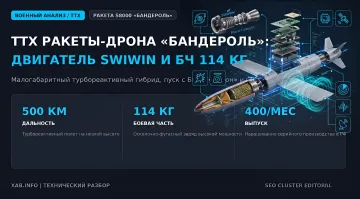
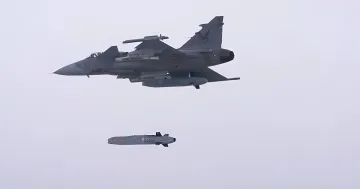
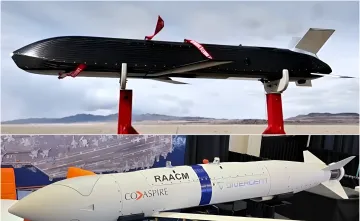
According to aggregated data from specialized publications (ura-inform.com, rbc.ru, focus.ua), the S8000 'Banderol' is a jet-powered cruise missile designed to strike ground targets at long range. Key parameters relevant to assessing crash risks include a warhead mass in the range of 114–150 kg of explosive, the presence of a turbojet engine, and the use of aviation kerosene as fuel. The transition to serial production, recorded in July 2026, indicates scaling of the carrier fleet and, as a consequence, an increase in the frequency of incidents involving course deviation or crashes in uncontrolled zones.
Mechanisms of Hidden Threat: Fuzes and the Chemical Factor
Emergency services specialists identify three groups of risks. The first — delayed-action and non-removable fuzes: electromechanical circuits with a self-destruction timer or tilt and motion sensors make any contact with a fragment potentially detonating. The second — the radius of total destruction: upon warhead detonation, the scatter of heavy casing fragments and structural elements is estimated at 500–700 meters, which determines the minimum withdrawal distance. The third — chemical hazard: evaporation of residual aviation kerosene and battery components can cause severe respiratory tract burns, requiring the exclusion of prolonged stay near the object even in the absence of visible fire.
Contradictory Data
Available sources show discrepancies in the assessment of the warhead mass. Some publications and incident descriptions cite a value of 114 kg, while other materials and safety memo formulations indicate 'up to 150 kg' of explosive. The discrepancy is likely explained by the difference between the basic configuration of the warhead block and its maximum loadout, as well as the use of rounded estimates in reference materials. Until the manufacturer publishes official technical specifications or verified data from sapper-pyrotechnic services is released, both figures should be treated as working estimates rather than exact parameters. This does not change the essence of the safety protocol, since both 114 and 150 kg of explosive require maintaining a 500-meter distance and complete exclusion of contact.
Civilian Action Protocol: Regulatory Algorithm
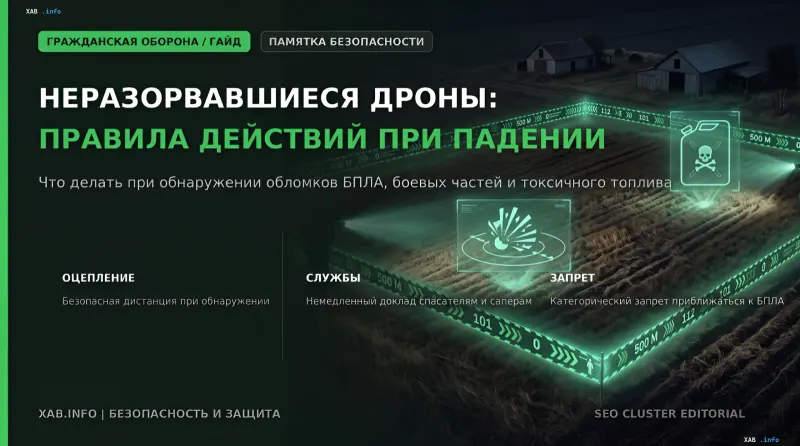
The algorithm of actions upon discovering a crashed drone or cruise missile reduces to the following sequence: stopping at a safe distance of at least 500 meters; a categorical ban on physical contact, moving fragments, or photographing from close range; refraining from using radio communications and smartphones right next to the object to avoid triggering a sensitive fuze; calling emergency services at 112, 101, or 102, specifying exact coordinates or recognizable landmarks; restricting access to bystanders, including neighbors and agricultural machinery drivers, until the sapper-pyrotechnic group arrives. For rural residents and farmers working in the fields, it is critically important not to approach the metal wings, turbojet engine, or gray fuselage fragments, and to retreat along the same route.
Systemic Consequences for Security Infrastructure
Regular crashes of cruise missiles create a sustained load on the duty shifts of the Ministry of Emergency Situations and the police, especially in agricultural regions where open terrain makes rapid detection of fragments difficult. This requires developing coordination between emergency services, local administrations, and agricultural enterprises, as well as regular public information on the action protocol. From a long-term planning perspective, serial production of carriers of this class implies the need to establish exclusion zones and evacuation routes near potential crash areas, as well as training agricultural machinery personnel to recognize dangerous fragments.
Long-Term Risks for Rural Areas
In the long term, the key risk is not a single incident but a cumulative effect: the combination of high warhead mass, toxic fuel, and delayed-action fuzes turns each crash zone into a potentially hazardous area for an indefinite period until sappers work on it. For the agricultural sector, this means temporary loss of arable land, the need to relocate fieldwork, and additional costs for ensuring personnel safety. A systemic response requires both operational measures — a clear protocol for calling and distancing — and strategic ones: verification of carrier technical specifications, development of risk-zone mapping, and integration of emergency services data with municipal planning.