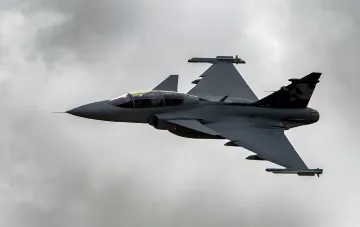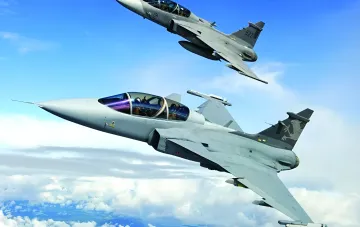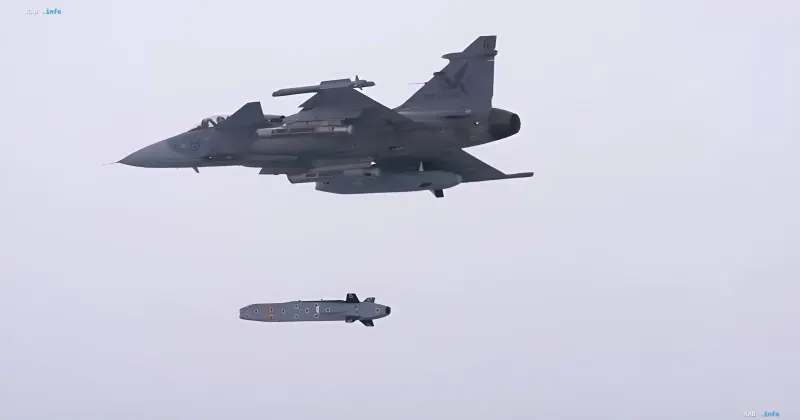
The Swedish Air Force press office released footage capturing the country's first-ever launch of a Taurus KEPD-350 cruise missile from a Saab JAS 39 Gripen C fighter. The event marks a key milestone in the transformation of the Swedish armed forces: for the first time in decades, Stockholm is demonstrating the ability to deliver long-range air strikes, a capability previously unavailable due to the long-standing neutrality policy pursued during the Cold War and into the early 2000s. The footage shows the missile separating from the underwing pylon and transitioning into horizontal flight, confirming the operational readiness of the aircraft-weapon system.
From Neutrality to Long-Range Strike Capability
Before joining NATO and the subsequent overhaul of its defense doctrine, Sweden deliberately limited its arsenal to short- and medium-range tactical weapons. The neutrality policy eliminated the need for long-range air-to-ground cruise missiles with ranges of hundreds of kilometers. The shift in strategic course and integration into the alliance opened the way to the procurement and integration of weapons previously inaccessible to the Swedish Air Force. It is in this context that the Taurus tests from the Gripen C carry not only technical but also geopolitical significance: Sweden is moving from perimeter defense to the ability to project force over considerable distances.
Taurus KEPD-350: Technical Specifications and Variants
The Taurus KEPD-350 is a long-range air-to-ground cruise missile developed jointly by Germany and Sweden. It is produced by Taurus Systems GmbH, a joint venture between Germany's MBDA Deutschland and Sweden's Saab Bofors Dynamics AB. The KEPD acronym stands for "kinetic energy penetrator and disabler." The officially stated range of the production variant is 500 km, with a cruise speed of 0.6–0.9 Mach. Guidance is provided by a combined system: inertial navigation, satellite positioning (GPS/GLONASS), and terrain correlation, which makes the missile resistant to electronic jamming. Several variants have been developed based on the KEPD-350: the lightweight KEPD-350L, the modular MP with interchangeable payload, versions for engaging dispersed targets and disabling electronic systems, as well as the Taurus T, adapted for launch from C-130 and A400M transport aircraft. In 2024, the manufacturer unveiled the Taurus Neo with an updated guidance system and extended range. In Europe, the missile is already in service on Tornado, Eurofighter Typhoon, and F/A-18 Hornet fighters.
Integration Timeline: From the 2000s to 2028
The history of cooperation between Saab and Taurus Systems dates back to the early 2000s, when one of the Gripen fighters was used as a test platform within the missile development program. Nevertheless, the Swedish government initially did not include Taurus in the Gripen's standard weapons system, despite Saab Bofors Dynamics being one of the founding members of Taurus Systems GmbH. A turning point came in February 2025, when Military magazine reported that Stockholm planned to procure and install Taurus KEPD-350 on Gripen C fighters. Starting in December 2025, the Saab consortium, together with the Swedish Ministry of Defence and the Defence Materiel Administration (FMV), accelerated the integration process. Swedish Air Force Commander Major General Jonas Wikman stated that progress is proceeding significantly faster than initially planned, and the program is expected to reach operational readiness by 2028. He did not specify exact dates, citing the confidential nature of the work. Saab has been tasked with upgrading both the Gripen C and Gripen E to employ the new weapon; initially, a small number of Gripen C aircraft are planned to be adapted for combat use with the Taurus missile system.
Conflicting Data
Open sources contain discrepancies in the wording of the full integration timeline. On the one hand, the description of the tests states that "new trials will ensure full integration of the missile by 2028 within the Gripen upgrade program." On the other hand, more detailed data indicate that the first fighters (Gripen C) will be equipped with missile-carrying systems by 2028, while full integration of Taurus into the Gripen E Block 4 configuration (designated MS23) is planned for 2033. Thus, 2028 likely refers to the operational readiness of the first batch of Gripen C, while 2033 refers to the completion of full-scale integration into the later variant. Major General Wikman, for his part, deliberately withholds exact dates, leaving room for interpretation. The two versions do not exclude each other but require clarification from the Swedish FMV.
Strategic Context and Regional Significance
The integration of Taurus on the Gripen C and E significantly alters the balance of power in Northern Europe. The ability to deliver precision strikes at ranges of up to 500 km (and even farther in the Taurus Neo variant) allows Sweden to influence the operational situation without sending fighters into zones where they are vulnerable to enemy air defenses. For NATO, this strengthens the alliance's eastern flank and creates an additional deterrent factor. For Ukraine, in particular, Sweden's integration of Taurus on the Gripen is seen as a potential source of long-range cruise missile supply in the medium term, although no official statements on weapons transfer have been made to date. The next expected step will be the demonstration of launches from upgraded Gripen E aircraft, which, according to Saab and FMV plans, is to take place within the MS23 program by 2033.