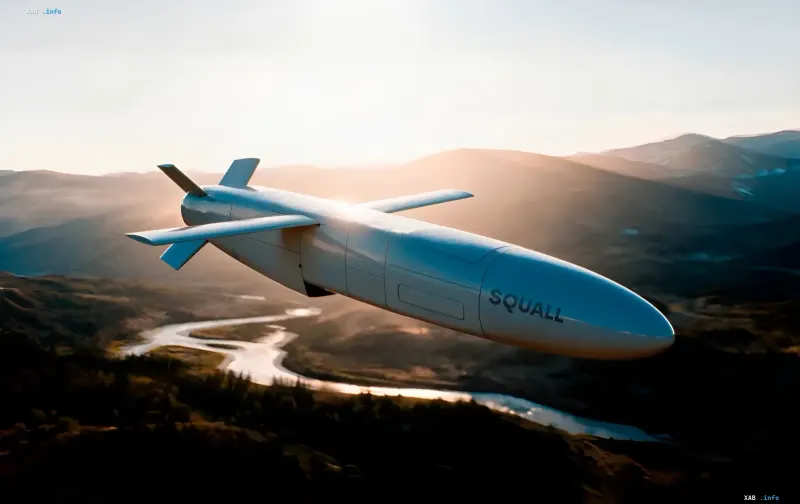
On September 16, 2026, Spanish defense company Indra publicly unveiled the Squall cruise missile for the first time at the UNVEX exhibition in San Javier (Murcia province) — the first fully Spanish development of this class. According to RBC-Ukraine, citing Army Recognition, the weapon is intended for strikes at ranges beyond 300 km against enemy command posts, air defense systems, and military infrastructure. Development is being carried out by the Indra Weapons & Ammunition division, and serial production is planned to be rolled out directly in Spain with the participation of other industrial partners.
The First Fully Spanish Development
The key difference between Squall and the Taurus KEPD 350 missiles already in Spanish service lies in the origin of the technology. Taurus is a German-Swedish development, although Spanish industry did take part in producing certain components and in integration. Squall, by contrast, is positioned as a fully national product for land- and sea-based deployment, which for Madrid means reduced dependence on foreign suppliers in one of the most sensitive segments of strike weaponry.
Range and Jamming Resistance
Squall's stated range exceeds 300 km. The missile is designed for low-altitude flight and for navigation that is resistant to jamming and GNSS signal spoofing. Indra claims to employ several guidance and navigation methods to counter jamming and electronic warfare, but the company does not disclose the specific sensors or the architecture of the navigation complex. This leaves a significant portion of the combat characteristics outside public access.
Saturation Strategy: Cost Matters More Than Range
In Indra's design, Squall's main advantage is not the range itself but the low unit cost, which is meant to allow the missiles to be purchased in large numbers for simultaneous massed strikes. An additional asset is launch flexibility: from launchers, containers, tactical vehicles, and ships. This allows ground units to disperse, receive target coordinates, fire, and change position without involving aviation — unlike Taurus, whose use requires an EF-18 carrier aircraft.
Contradictory Data
Despite the high-profile positioning, Indra has not published a number of basic specifications: speed, dimensions, launch mass, engine type, warhead mass, and cruise altitude. The target unit cost is also not disclosed, even though this figure, together with production rates, will determine whether Squall truly becomes a mass saturation weapon or remains a limited-quantity system. At the same time, the political question remains open: in late August, calls were made in Germany to threaten Russia with transferring Taurus cruise missiles to Kyiv in response to hybrid attacks on German infrastructure, making the topic of long-range weaponry in Europe especially sensitive.
European Context
The theme of cheap cruise missiles for mass strikes is actively developing in other European countries as well. For example, in August 2026 a Romanian company successfully tested the AI-controlled Sahara cruise missile, also conceived as a cheap alternative to classic long-range strike means. In this lineup, Spain's Squall looks like a logical continuation of the European trend toward reducing the cost and saturating strike capability without relying on single expensive systems.