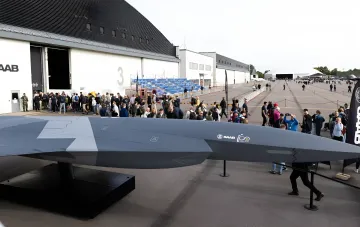
Swedish corporation Saab Group has unveiled an updated conceptual model of the A3 unmanned aerial vehicle, developed for joint operation with manned fighters as part of an integrated combat system. The company announced this in a press release, while details of the roadmap were disclosed to journalists at a press conference held at Malmö airbase as part of the celebrations marking the 100th anniversary of the Swedish Air Force. According to Saab representatives, the aircraft is intended for high-risk missions: conducting electronic warfare, suppressing enemy air defense systems, and delivering precision strikes in areas of intense resistance.
The A3 Concept and Its Role in the System
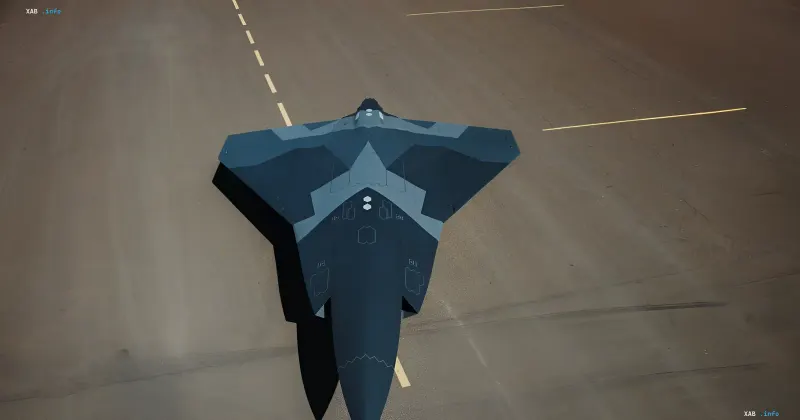
The A3 model retains the key features of the previous exhibition version, which Saab first displayed in 2024: a tailless aerodynamic layout, a low fuselage, and a fairly spacious internal volume for carrying fuel and weapons. The angular stealth geometry of the surfaces, visible in the published images of the aircraft on the concrete pad, is designed to reduce radar cross-section. As Peter Nilsson, director of Saab's future programs division, explained, the company is in an intensive development phase and, together with the Swedish Ministry of Defence, is researching the technologies that will form the basis of next-generation fighters.
The ACP Roadmap and the KFS Project
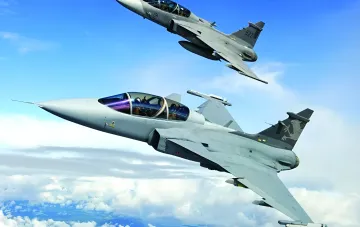
According to The War Zone, Saab presented journalists with the roadmap for the Automated Combat Platform (ACP) program. Nilsson stated that the ACP is part of the larger Swedish KFS project — Koncept för Framtida Stridsflygplan, or "Concept for a Future Fighter." As part of this work, the company plans to conduct unmanned test flights by 2030 with characteristics as close to a fighter as possible, so that Sweden can evaluate prospective options for further development. Nilsson emphasized that the A3 "would be an excellent platform for teaming with the Gripen E," although at present the company has no commitments to series production of the A3 model.
The A1 and A2 Prototypes: Supersonic Testing
In addition to the A3 concept, Saab is researching and developing the A1 and A2 drone prototypes, funded by the Swedish Ministry of Defence. The first flight of the A1, equipped with GE Aerospace F414 engines — the same ones used on the manned Saab Gripen E/F fighters — is expected within the next 15 months, and the aircraft is expected to reach supersonic speed. The A1 will feature an internal weapons bay, however no testing of dropping or launching munitions from it will be conducted: the main goal is to demonstrate the company's ability to produce and deploy stealth drones. The next prototype, the A2, will also have an internal bay and will likely be used to test various types of weapons, as well as new materials, sensors, and the F414 engine. Saab's contract provides for the development of the A1 and A2 models by 2030.
Contradictory Data
It is important here to distinguish between two versions that give rise to inaccurate formulations in the media. On the one hand, a number of publications characterize the A3 in their headlines as a "supersonic stealth drone" and a "powerful" aircraft. On the other hand, in the text of the press release itself and in Saab's comments, the supersonic characteristics are explicitly tied to the A1 prototype, not to the A3 concept, which remains a model without confirmed tactical and technical specifications and without a series production contract. Thus, the громкие headlines about a "supersonic A3" do not fully match the factual status: the supersonic one is the A1, while the A3 at the current stage is a concept within the research framework. This does not refute the fact of the model's presentation, but it calls for a cautious interpretation of its capabilities.
Economics and Prospects
According to Saab's estimates, if the Swedish armed forces support the project, the A3 model could be introduced into service in the early 2030s, with initial operational readiness achieved by the middle of that decade. The company cites cost as the key economic argument: by Saab's calculations, operating the ACP over its entire life cycle would cost roughly one third of the cost of a Gripen fighter. This makes the concept attractive from a budgetary burden perspective, although the final decision on series production remains with the Swedish Ministry of Defence.