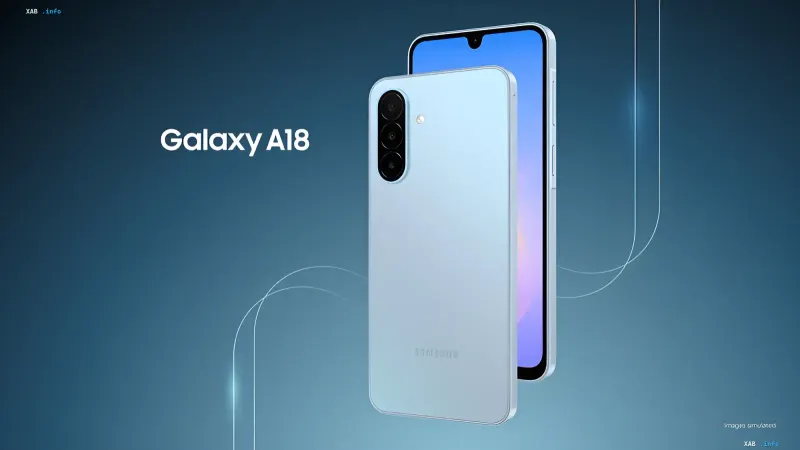
Samsung has officially launched the Galaxy A18 4G smartphone in Singapore. However, as it turned out, the version for the local market is not built on the same system-on-chip used in the European model. This makes the Singaporean variant a notable example of how the same smartphone is supplied to different markets with different chipsets.
Two platforms for one device
In Europe, the Galaxy A18 4G is powered by the Samsung Exynos 1610 system-on-chip, whereas the Singaporean variant is built on the MediaTek Helio G99+ SoC. Effectively, the smartphone has received a second platform. For the A-series, this is an unusual decision, as regional differences usually concerned memory capacity or the software shell, rather than the processor itself.
General specifications
Otherwise, the device specifications match. The smartphone features a 6.7-inch Super AMOLED screen with Full HD+ resolution and a 90 Hz refresh rate, a 5000 mAh battery with 25W charging support, and a camera with 50, 5, and 2 MP sensors. For security, there is a side-mounted fingerprint scanner, and dust and water resistance complies with the IP64 standard.
Software and memory
The Singaporean version runs on Android 17 with the One UI 9 shell, featuring 4 GB of RAM and 128 GB of flash storage. In the European market, a modification with 256 GB of internal storage is also available. Thus, the software platform and RAM capacity are identical in both regions, with only the storage options differing.
Price and terms of sale
In Singapore, the Galaxy A18 4G is priced at 328 Singapore dollars, which is approximately 255 US dollars or 230 euros. Buyers are offered three colors: black, blue, and silver. A discount of 30 Singapore dollars is available until December 8, and some stores promise a free 25W power adapter as a bonus.
The launch of the Galaxy A18 4G in Singapore confirms the trend towards regional adaptation of the hardware platform even in the budget segment. For the end user, this means that when choosing a specific device, it is important to pay attention not only to the marketing name, but also to the chipset, which may differ depending on the supply market.