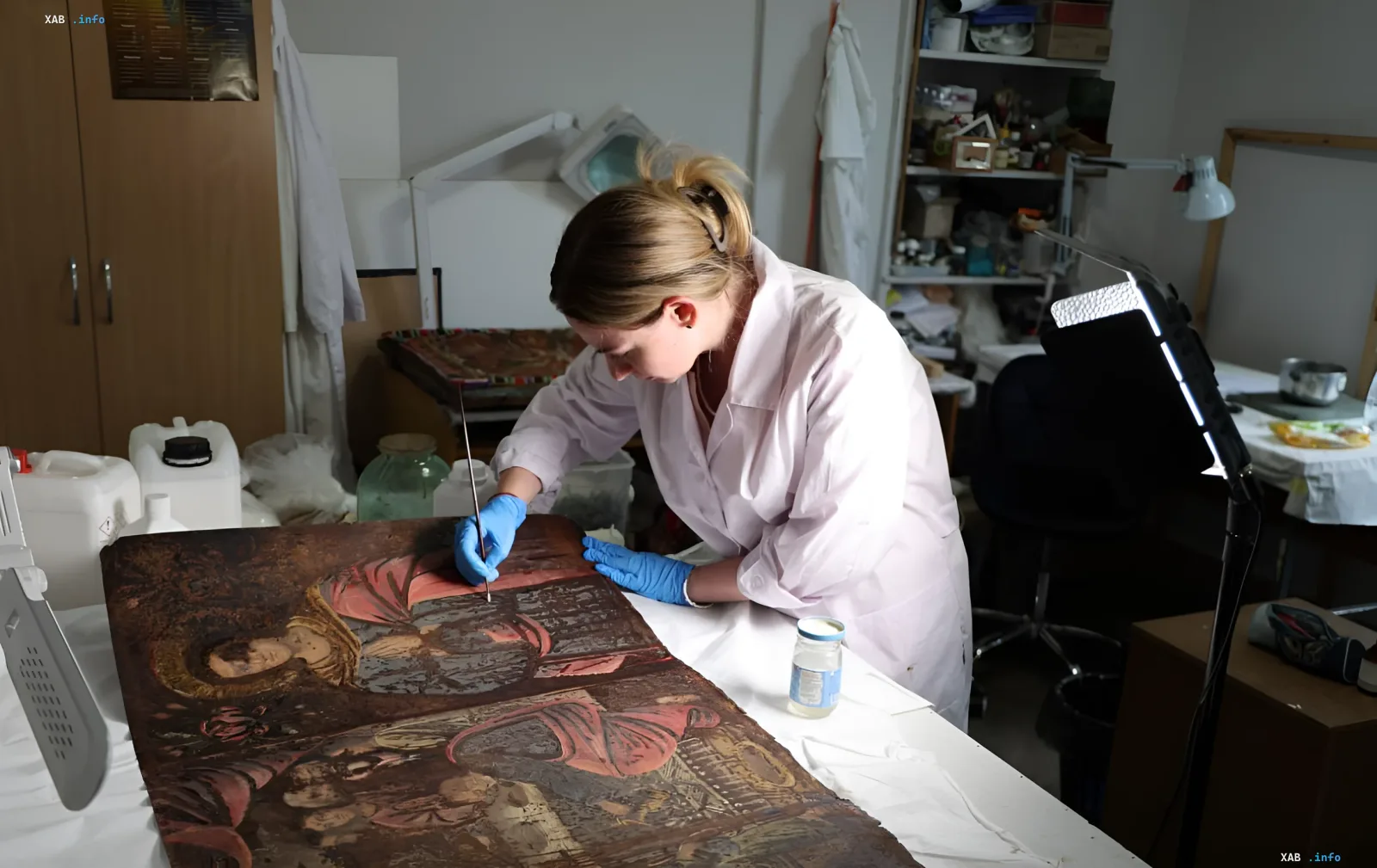
In the workshops of the National Research and Restoration Center of Ukraine (NRRCU), there is a special atmosphere. Daylight streams through the large windows, but it is not enough for the work. Powerful lamps shine over every table, illuminating darkened icons, cracked wood, and ancient canvases. Here, in silence, people in white coats fight against time and war, bringing the country's cultural memory back to life.
A new reality: from 5-year plans to saving from rockets
Before the start of the full-scale invasion, the work of restorers was built on five-year plans. This was a painstaking process aimed at preserving history, not creating "new" things. However, the events of 2022 radically changed their activities. In addition to routine scientific work, an emergency task was added — saving museum collections from destruction. Restorers began helping museums to inspect, pack, and evacuate exhibits. During the war, center specialists have already inspected 23,000 items, of which more than 5,600 have been restored.
Rescue technologies: X-ray and chemical analysis
The restoration process is complex scientific work. Before an artist takes a brush in hand, every exhibit undergoes a thorough examination. If there is a suspicion that an earlier painting is hidden under the top layer, the icon is sent for X-ray. This allows assessing the condition of the base, revealing through-damage or deformations. Photofixation and chemical analysis are also conducted, which help determine the composition of paints and the approximate date of creation of the work. Only after this is a restoration plan drawn up.
Features of Ukrainian icon painting and folk masters
One of the objects of restoration was the "Last Supper" icon of the 19th century, found in the funds of the "Khortytsia" museum. The exhibit was so damaged that it would not have survived evacuation, so it was taken to Kyiv. The peculiarity of this icon lies in the material: instead of the usual canvas, the amateur master used a metal base, which over time became covered with rust. The plot also differs from the canonical one: Saint Nicholas and Saint Barbara are depicted on the edges. Deputy General Director of the center Tatyana Bychko notes that Ukrainian icon painting differs significantly from the Russian tradition. Our masters often deviated from strict canons, preserving only individual elements, which formed a unique style of Ukrainian sacred art.
Ethics of restoration: why old paints are not used
Restorers do not strive to completely recreate the appearance of the icon as it was at the time of writing. The goal is to preserve the authenticity and history of the item. For example, when restoring oil painting, specialists do not use paints from that time. Oil pigments change their shade within the first year after drying, and ancient masters used complex mixtures, the exact composition of which is impossible to reproduce. Even changing the ratio of components by a milligram can distort the color. Therefore, restoration is aimed at strengthening the connection between the base and the paint layer, preventing further destruction, rather than creating a "new" work.