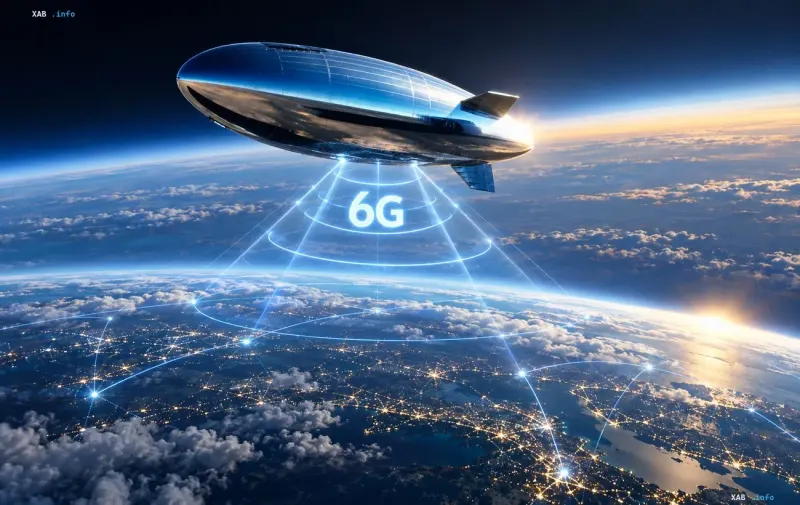
American aerospace company Sceye has successfully completed the Service Test 1 mission, testing an innovative stratospheric platform to provide 6G mobile communications. The vehicle completed a transoceanic flight from New Mexico to Japan and back, covering a total distance of approximately 30,500 kilometers over 30 days.
Transoceanic Flight and Testing Details
The large-scale test mission demonstrated the high reliability of Sceye’s high-altitude equipment, known as SceyeCELL. During the flight, the vehicle spent 7 days in Japanese airspace under the direct control of the Japanese side. Throughout this period, the system provided stable broadband mobile connectivity directly to both modified and standard consumer smartphones on the network of Japanese telecom giant SoftBank Corp.
Sceye Founder and CEO Mikkel Vestergaard Frandsen noted that the tests confirmed the readiness of all key infrastructure elements. According to him, the stratosphere could become the foundation for continuous 6G network coverage in the future.
Advantages of HAPS Platforms over Satellite Internet
Sceye's developments fall under High Altitude Platform Systems (HAPS), which operate in the stratosphere at an altitude of about 50 kilometers. Unlike traditional satellite systems, such as Starlink orbital constellations operating in the thermosphere and exosphere 2,000 kilometers above the Earth, stratospheric platforms are located much closer to the planet's surface.
This geographical proximity ensures significantly lower signal latency and faster connections compared to space-based alternatives. Furthermore, the economic efficiency of HAPS is impressive: Sceye estimates that a single fully deployed platform can replace approximately 500 standard terrestrial mobile towers while requiring only a fraction of the astronomical costs needed to launch and maintain orbital constellations.
The Future of Global Telecommunications Infrastructure
The new technology is positioned by experts as a direct and promising alternative to existing direct-to-cell satellite solutions for mobile devices. Combining the capabilities of high-altitude platforms with terrestrial networks can completely transform the approach to covering remote and hard-to-reach regions of the planet.
The successful completion of the Service Test 1 mission paves the way for Sceye to commercialize the project and cooperate further with leading global telecom giants. Amid growing demands for network capacity, stratospheric communication may become the missing link between ground towers and space satellites.