Washington has publicly warned Europe of risks to American business if Brussels restricts US companies' access to the European satellite communications market. According to the Financial Times, this was stated by US Ambassador to the EU Andrew Puzder, as cited by RBC-Ukraine. In his assessment, such measures could lead to 'serious losses' for European companies as they would reduce competition and limit choices for consumers and industry customers.
What Exactly Brussels is Proposing
The catalyst for the reaction was a recent European Commission initiative to allocate a portion of the radio frequency spectrum exclusively for European companies. According to Brussels, the goal is to facilitate the entry of new European suppliers to the market and expand their circle. At the same time, the Commission clarified that companies from non-EU states will still be able to operate on the European market, although access to the dedicated 'European' frequency segment will be restricted for them. The initiative fits into the EU's broader policy of strengthening technological independence and reducing dependence on American corporations.
Washington Accuses Brussels of Protectionism
US Ambassador to the EU Andrew Puzder criticized the European Commission's approach, calling it protectionism and an attempt to create advantages for European companies at the expense of US competitors. He also expressed dissatisfaction with the EU's general regulatory policy in the tech sector. According to him, Washington and Brussels should join forces to compete more effectively with China in areas such as artificial intelligence and quantum computing, rather than restricting each other.
Risk to Communications in Ukraine
Separately, SpaceX warned that frequency reservation could negatively impact communication quality in Ukraine, where the Starlink network provides critical communication channels for civilians and the military. This turns the radio frequency dispute from a purely commercial one into an issue affecting the operational resilience of a country at war, potentially impacting logistics and on-the-ground coordination.
Context: Technological Sovereignty and Response to China
The European Commission's initiative is not an isolated step, but part of the EU's long-term strategy to reduce technological dependence on the US and China and build its own 'digital sovereignty.' Against this backdrop, Washington's position, calling for joint competition with China in AI and quantum computing, looks like an attempt to prevent a fracture in the Western technological alliance. The divergence in interpreting the same measure — 'market expansion for new European players' from Brussels' perspective and 'protectionist restriction' from Washington's — reflects a deep disagreement on how to shape tech policy amid geopolitical competition.
Starlink Alternatives Already Underway
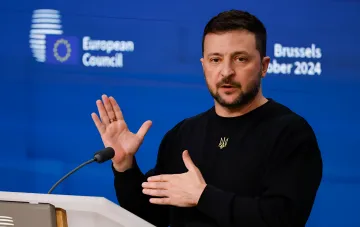
The situation is complemented by recent statements from Kyiv. Ukrainian President Volodymyr Zelenskyy reported that Europe is already working on a Starlink equivalent and confirmed that Ukraine is also developing its own satellite system. These steps, if implemented, could in the medium term reduce Ukraine's dependence on American communications infrastructure while strengthening Brussels' argument for European alternatives. However, in the short term, Starlink remains the key communication channel, making the frequency dispute sensitive for Kyiv.