For decades, astrophysicists have faced a mystery: a significant portion of the ordinary matter that should have formed in the early Universe was not found in stars, planets, or galaxies. A new study, recently published, has finally shed light on this problem. It turns out that the missing matter did not disappear without a trace — it is hidden in giant, almost invisible clouds of gas surrounding galaxy clusters.
Where is the missing matter hiding?
The term "ordinary matter" in astrophysics refers to baryonic matter — substance consisting of protons and neutrons. According to calculations, approximately 17% of the early Universe consisted of baryons. However, when counting the mass of all visible objects — stars, galaxies, and planets — scientists found only about 10% of this amount. Where did the remaining 90% go?
For a long time, hypotheses were built around the idea that this matter must exist as cold, rarefied gas in intergalactic space. But confirming this was extremely difficult due to the low density and darkness of such clouds.
Fast Radio Bursts as a Search Tool
The breakthrough became possible thanks to the use of a unique cosmic phenomenon — fast radio bursts (FRBs). These short-term but extremely powerful bursts of radio waves were first detected in 2007. Their nature is still not fully understood, but their energy allows them to "outshine an entire galaxy".
Researchers from the Massachusetts Institute of Technology (MIT) and other scientific centers analyzed thousands of such bursts. They paid attention to how the signal is distorted when passing through cosmic matter: the more matter in the path, the stronger the "smearing" in time. This smearing is directly proportional to the amount of baryonic matter through which the signal passed.
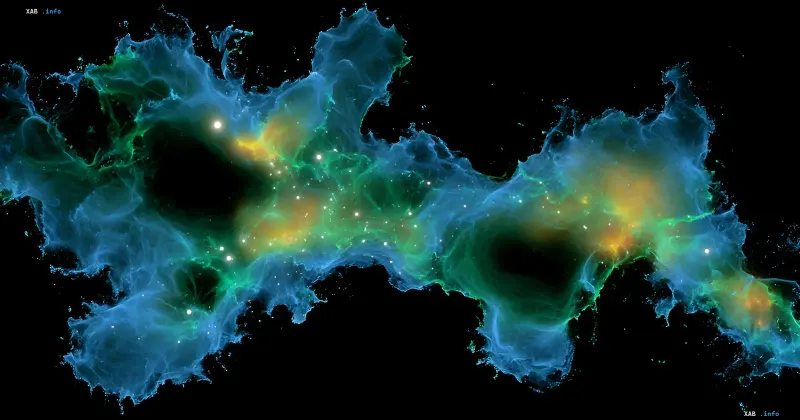
By comparing data on smearing with maps of the locations of more than 6 million galaxies, the team identified a clear pattern: the missing matter does indeed exist, but it is distributed in the form of diffuse clouds at a distance of up to 4 million light-years from galaxies — significantly further than computer simulations predicted.
Matter Fountains from Black Holes
What can eject gas to such huge distances? Scientists suggest that high-energy processes in the centers of galaxies play a key role — in particular, jets of plasma emitted by supermassive black holes, as well as supernova explosions.
Haochen Wang, the lead author of the study and a graduate student at MIT, noted: "We are finding that activity in galaxies is much more chaotic than we thought. They resemble fountains more and really push gas to very large distances".
These data not only solve a long-standing mystery but also indicate that galaxies are much more active and dynamic than previously thought. The energy spent on ejecting matter turns out to be significantly higher than models predicted.
A New Stage in the Study of the Universe
Despite the success, many questions remain open. For example, what is the exact structure of these clouds? How exactly do they interact with galaxies? And how quickly do they dissipate in the intergalactic medium?
However, it is already clear: fast radio bursts have become a powerful tool for mapping the invisible matter of the Universe. With each new detected FRB, scientists get more and more data that could overturn our understanding of space.