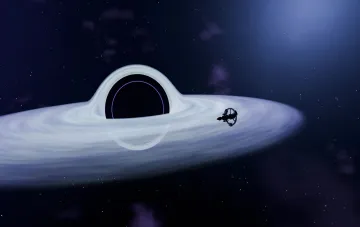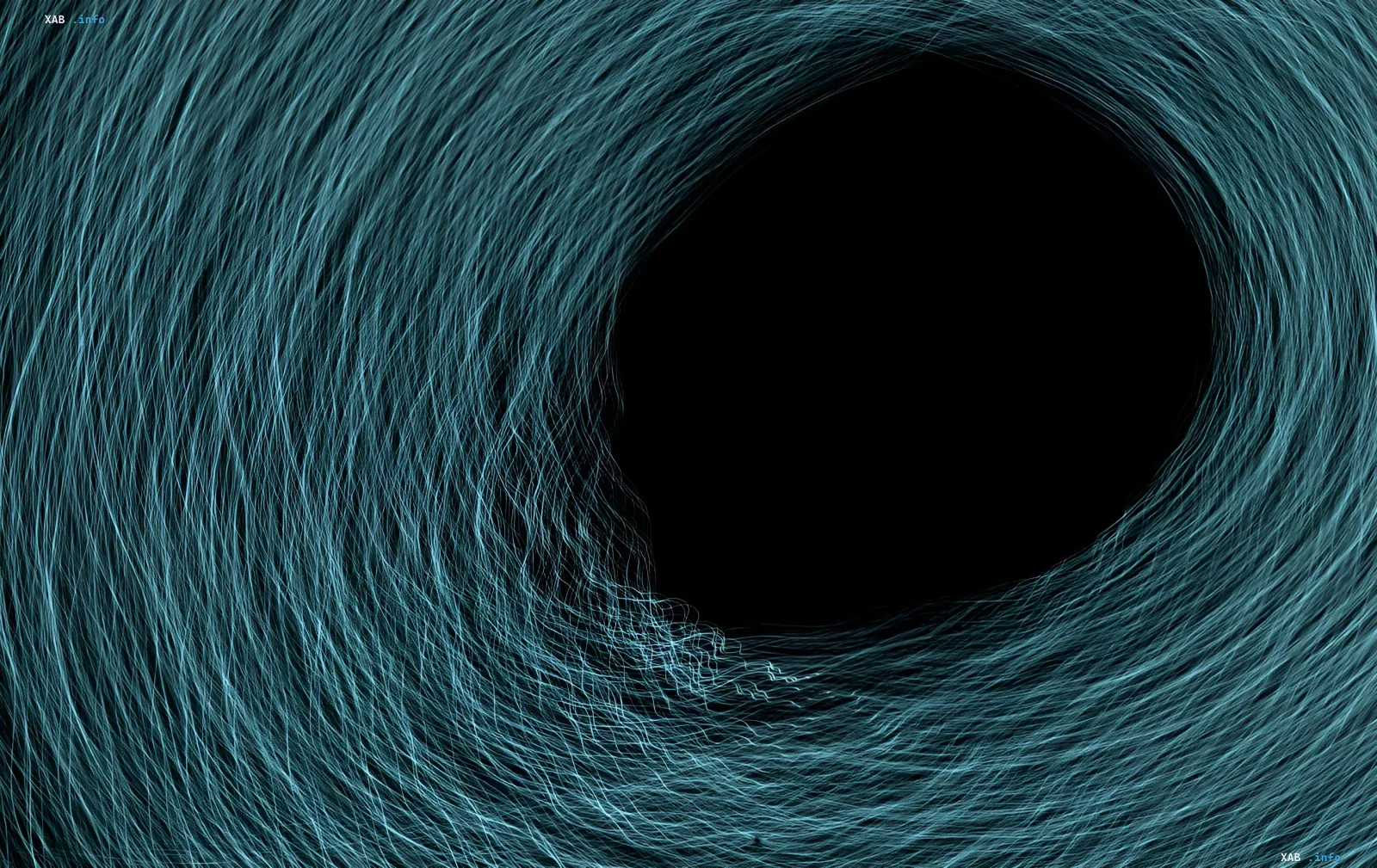
A breakthrough has occurred in the world of theoretical physics that could revolutionize our understanding of the most mysterious objects in the Universe. Scientists have proposed a radically new explanation for what happens at the center of a black hole. The long-dominant theory regarding the existence of an infinitely dense point—a singularity—has been challenged by a new study published in the prestigious journal Physical Review D.
From Point to Ring: The Evolution of Misconceptions
The notion that a singularity is a dimensionless point was formed back in the 1930s. This model was convenient for calculations and simple to explain, so it became firmly established in textbooks. Later, in the 1960s, physicists discovered that in rotating black holes, centrifugal force stretches this singularity into a ring. However, for static black holes, the "point" model remained an axiom.
The situation changed thanks to a thought experiment conducted by Andrew Hamilton from the University of Colorado Boulder and Tyler MacSween from the University of Maryland. They modeled a scenario in which two researchers fall into a black hole from opposite sides.
The Paradox of Meeting: Why Astronauts Cannot Collide
According to the simple "textbook" theory, if there is a point at the center, both astronauts must inevitably collide or end up at the same spacetime coordinate. However, upon closer examination through the lens of general relativity, the picture changes.
During the fall, the extremely curved spacetime moves toward the center faster than the speed of light. This completely breaks the causal link between the observers. They cannot exchange any signals, are unaware of each other's existence, and are physically incapable of meeting.
Scientists draw a logical conclusion: if the passengers cannot arrive at the same event in space and time, they cannot be heading toward a single point. This contradiction disappears only under one condition—if the singularity is an extended three-dimensional surface, to which each observer arrives at their own, isolated location.
"I always joke with students that black holes constantly challenge my intuition. Yes, this was a surprise. But at the same time, it finally put everything in its place," noted Andrew Hamilton.
A New Key to Quantum Gravity
This discovery has colossal significance for fundamental science. Modern physics relies on two "pillars": Einstein's General Theory of Relativity, describing gravity and space, and quantum mechanics, explaining the world of atoms. Inside black holes, these theories contradict each other and cease to function.
Physicists have been searching for "quantum gravity"—a unified theory capable of explaining the Universe at all levels—for over a century. Reimagining the singularity as a three-dimensional surface changes the mathematical conditions under which familiar laws of physics cease to operate. It is precisely these boundary surfaces that become the only place in the Universe where quantum gravity manifests in reality, providing scientists with the correct starting point for further calculations.