For a long time, the scientific community held the view that black holes are bottomless cosmic "vacuum cleaners," swallowing everything that enters their gravitational field, practically without a trace. However, new data obtained by astronomers forces a re-evaluation of this established theory. It turns out that these mysterious objects do not just absorb matter but actively eject a significant portion of it back into space.
A flare that changed our view of the universe
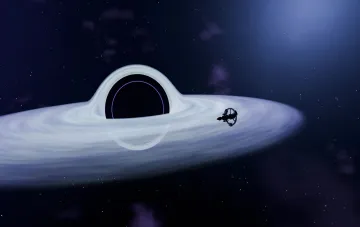
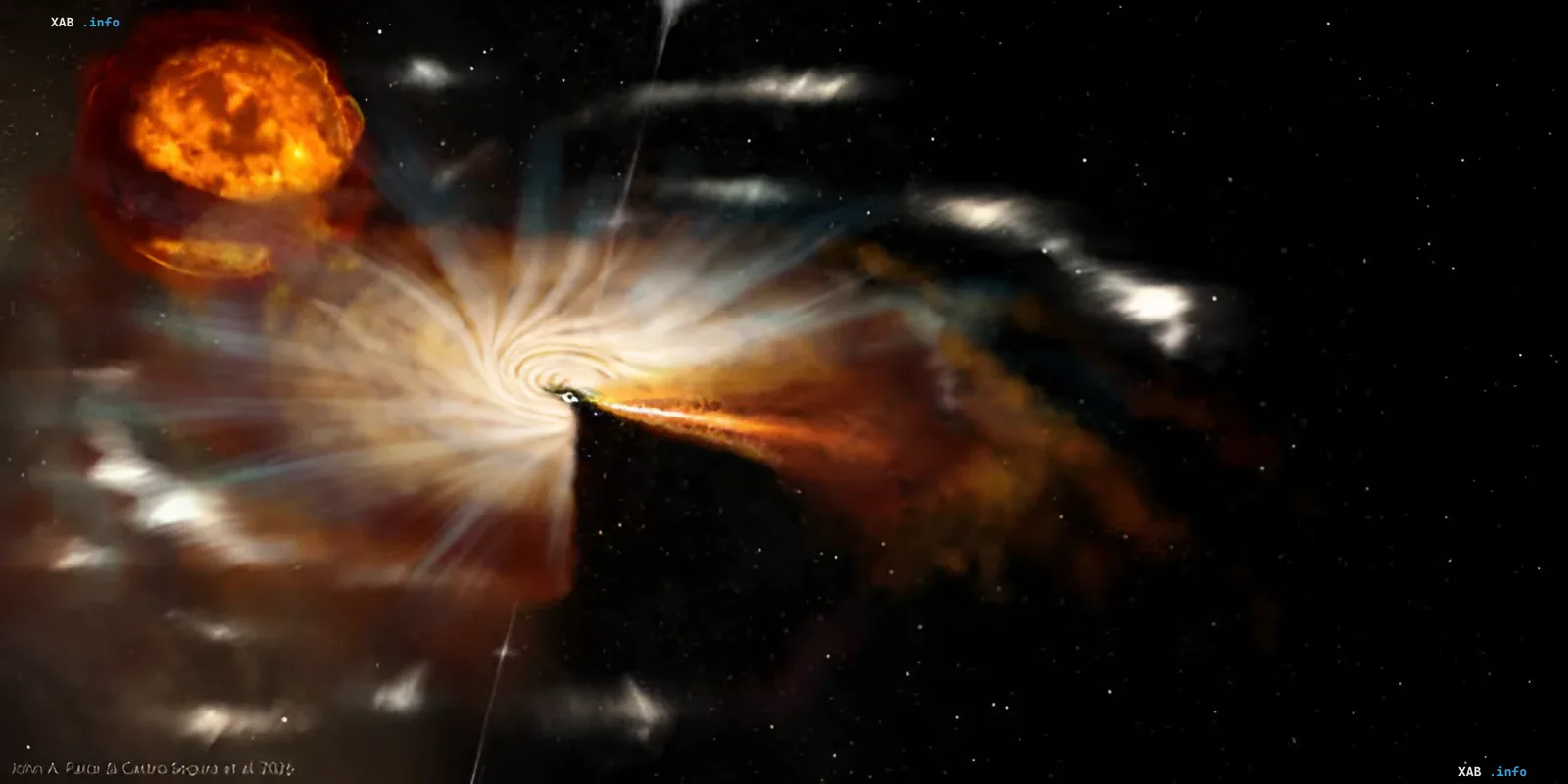
The key discovery was made during observations of the binary system Swift J1727.8−1613. In 2023, this system suddenly became active, turning into one of the brightest X-ray sources in the sky. During the flare, the black hole began actively pulling gas from its neighboring star, forming a rotating accretion disk of superheated matter around itself.
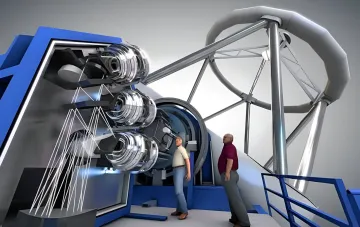
To study the process in detail, scientists used the Very Large Telescope (VLT) of the European Southern Observatory, equipped with the X-Shooter spectrograph. Thanks to a series of observations, researchers managed to record not just a static moment, but the dynamics of changes in the entire system in real-time.
Mechanism of matter ejection
Observations showed that the process of interaction between a black hole and matter is much more complex than previously thought. Alongside absorbing gas, the object ejected matter outward. This process occurred in two forms:
- Narrow, high-speed jets.
- Broader flows resembling powerful cosmic winds.
The most unexpected finding was that the ejections did not stop immediately after the peak of activity. Even when the system's brightness dropped to one-hundredth of its maximum level, dense streams of matter continued to emerge from the accretion disk. According to researchers' estimates, the black hole may have ejected almost as much matter as it managed to absorb.
New dynamics of black hole evolution
These data cast doubt on the accepted dynamics of black hole evolution in science. It was previously believed that the efficiency of their "feeding" was extremely high. In practice, however, it turned out that black holes absorb matter with much lower efficiency. At the same time, the jets and winds created by them have a colossal impact on the distribution of matter not only within the system but far beyond its boundaries, returning processed matter back into cosmic space.