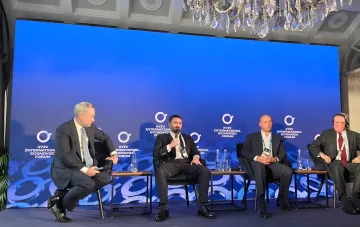
Oleksandr Kalenkov, President of Ukrmetallurgprom (UMP), has put forward a specific financial demand regarding the government-debated initiative to launch steel scrap export auctions. According to him, if the Cabinet of Ministers decides to permit limited scrap exports through an auction model, the starting price for the quota must be at least €80 per ton. Kalenkov stressed that the auction procedure itself does not guarantee a fair price, as the Ukrainian scrap export market is monopolized and controlled by a limited circle of players. «In a consolidated market, there is a risk that the quota will be sold cheaply, while the main windfall profit from exports will remain with private companies, which is what they are fighting for and seeking support for in government offices. Therefore, the starting price must be no less than €80 per ton», he explained.
Windfall profit mathematics: three scenarios based on starting prices
To illustrate the risks, Kalenkov cited calculations based on current market prices. According to his data, scrap metal in Poland costs about €290 per ton, while at a Ukrainian terminal its price is around €149, with another €28 or so going toward logistics and terminal services. If the quota were effectively given away without a starting fee, the potential windfall profit for the exporter would be about €113 per ton, totaling €22.6 million for a volume of 200,000 tons, while the budget would receive nothing from the quota sale. At a starting price of €27 per ton, the state would receive only €5.4 million, while about €17.2 million in potential windfall profit would remain with the exporters. Only with a starting price of €80 per ton could the budget receive €16 million, while exporters would retain about €33 in additional profit on each ton — roughly €6.6 million across the entire quota volume. «In other words, at a quota price above €80 per ton, export remains economically profitable. Since we are not talking about making it unprofitable, the only question is who will get the additional income from access to the external market — a few traders or the Ukrainian budget», emphasized the UMP President.
Where to get 200,000 tons and what to do with the raw material
Kalenkov also noted that the potential quota of 200,000 tons could largely be supplied by western regions of Ukraine, where transportation costs for delivering scrap to the border are relatively low. At the same time, he stated, the state is obliged to compare revenues from raw material exports with the effect of domestic processing. «If the state cannot get an adequate price for the right to export scrap, then a simple question arises: why rush to export it at all? Scrap can be left in Ukraine and used after metallurgical enterprises resume operations, where it creates significantly greater value added», he pointed out.
Uniform rules with no exceptions for state-owned companies
As a separate condition, Kalenkov stated that there should be no exceptions for state-owned companies. «The rules must be the same for everyone. If a state-owned company sells scrap, it must also do so transparently, under general conditions. Any exceptions create unequal competition and room for abuses and budget shortfalls», the expert emphasized. He added that Ukrainian metallurgical enterprises are ready to buy scrap on the domestic market and participate in transparent auctions. «If we are going to open up exports through auctions, the state must receive a fair payment for it. Otherwise, we will simply create windfall profits for scrap metal sellers while the State Budget loses revenue and Ukrainian industry loses raw materials for processing», the UMP President summarized.
Earlier, the Federation of Metallurgists also stated that Ukraine should not open scrap metal exports until the state creates a model guaranteeing a fiscal effect for the budget and protection of the domestic market. Thus, the position of industry associations and UMP's argumentation converge on one point: without transparent auction mechanics with an adequate starting price and without comparing export revenues with the effect of domestic processing, opening the market could result in the loss of the raw material base for metallurgy and undercollection of revenues by the state budget.