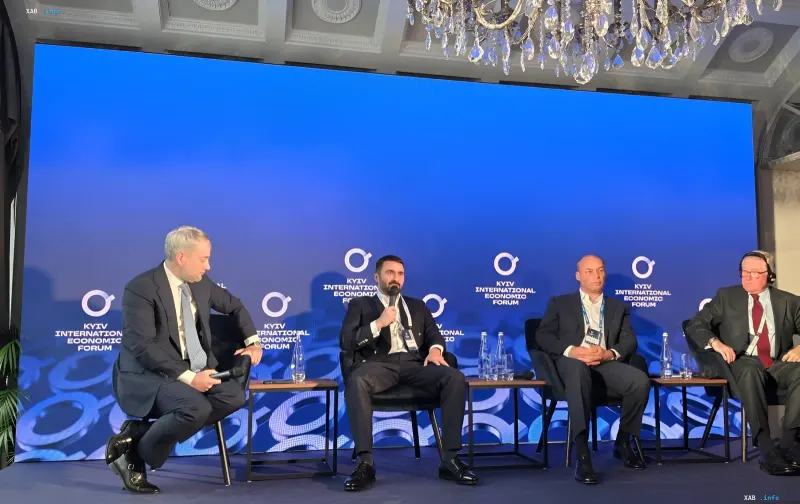
Oleksandr Vodovoz, Head of the CEO's Office at Metinvest Group, spoke at the Kyiv International Economic Forum with a detailed analysis of the European Union's trade policy regarding Ukraine's metallurgy. According to him, quotas for importing Ukrainian steel into the EU have been cut by more than 60%: while previously Ukraine supplied about 2 million tonnes of metal products annually to the European market, the available volume is now around 670,000 tonnes. At the same time, Vodovoz emphasized that part of the allocated volume was distributed among countries on a first-come, first-served basis — Turkish producers, according to his data, booked 360,000 tonnes within the first two days. "That's the whole 'honest' approach of the European Commission to Ukraine for you," he stated, commenting on the quota allocation mechanism.
Unpredictability of EU Trade Policy and the Risk of Long-Term Quota "Freezing"
Vodovoz described the European Union's trade policy as unpredictable. According to him, in 2025 Ukraine was given signals that there would be no new restrictions in the form of the Carbon Border Adjustment Mechanism (CBAM) and quotas, yet both instruments were ultimately introduced. Metinvest is particularly alarmed by the quota revision methodology: the European Commission analyzes steel import volumes for six months — from July to December — and based on these data can determine quotas for the next 5–10 years. "We are very worried that due to destroyed plants, we cannot supply products right now. There is a risk that based on these six months, we will be set a minimum quota for the next 10 years," Vodovoz warned. Thus, a temporary decline in exports caused by wartime destruction of production facilities could be locked in as a "norm" for a decade.
Russian Slabs and Lobbying Activity in Brussels
At the same time, according to the Metinvest representative, quotas for importing Russian slabs into the EU were fixed at a historical level for five years, which essentially means maintaining access for Russian products without significant reduction. Vodovoz also claimed active lobbying work by Russian representatives in Brussels aimed at restricting Ukrainian steel's access to the European market. "We see that the Russian lobby is present in Brussels. They hire companies, they fight to keep Ukraine out of Europe. And when we enter some offices, a Russian delegation is walking out," he said. These statements are Metinvest's assessment and have not been publicly confirmed or denied by the European Commission.
Financial Losses and the Ukraine Facility Issue
According to estimates by the GMK Center analytical center, due to the new quotas Ukraine will lose $850 million to $1 billion in export revenue, with another $400–450 million in export losses resulting from the CBAM mechanism. In total, potential losses by the end of the year exceed $1 billion. Meanwhile, Europe remains the main market for Ukrainian metallurgy: due to the war, high electricity costs, rising Ukrzaliznytsia tariffs, the need for insurance, and problems with maritime logistics, deliveries to distant markets have become significantly less profitable. Vodovoz singled out the Ukraine Facility as a separate problem: out of about $8 billion earmarked for business, Ukrainian companies, by his estimate, have received at most about $200 million.
What Metinvest Proposes to Protect the Interests of Ukrainian Metallurgy
Metinvest believes that Ukraine needs to more actively defend its interests in negotiations with the EU. Among the necessary steps, Vodovoz mentioned war risk insurance, attracting donor funding to restore the industrial base, and expanding Ukrainian companies' access to international financing sources. Without changing the approach to trade policy and financing, Ukraine risks losing its positions on the European market for a long time precisely when its own enterprises are operating under war conditions and limited logistics, the Head of the CEO's Office at Metinvest Group summarized.