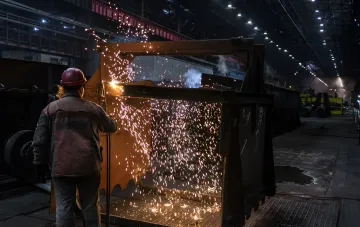
Ukraine's mining and metallurgical complex is going through the most severe crisis in the entire history of the country's independence. In August–September 2026, Russia deliberately intensified strikes on key metallurgical enterprises in Ukraine, while simultaneously continuing the naval blockade of the ports of Greater Odesa. As a result, two plants that accounted for more than 70% of the country's steel production were fully or partially shut down, and monthly output of steel and rolled metal fell by half compared to August 2025. According to the assessment of People's Deputy and Vice-Chair of the Parliamentary Committee on Economic Development, Dmytro Kyselevskyi, the industry has found itself in a state of a "perfect storm" — the simultaneous overlap of military, logistical, and economic pressure factors.
Chronology of the Strikes: From "Zaporizhstal" to "Kametstal"
In August 2026, two attacks were carried out against "Zaporizhstal" (part of the "Metinvest" group). A repeated ballistic missile strike on August 27 forced the enterprise to halt operations entirely. As a result of both attacks, employees of the plant were killed, more than 20 people were injured, and the energy and transport infrastructure, as well as the blast furnace and coke-chemical production, were damaged. In mid-September, the Russians attacked Ukraine's largest metallurgical enterprise — "ArcelorMittal Kryvyi Rih": two people were killed, 13 workers and employees of contractor organizations were injured, and the plant partially halted operations. On September 12, ballistic strikes were delivered simultaneously to "Zaporizhstal" and the enterprise in Kryvyi Rih. Thus, the adversary left or limited the operations of two plants that together produce more than 70% of Ukraine's steel.
In early September, "Kametstal" in Kamianske (Dnipropetrovsk Oblast, a "Metinvest" entity) came under attack — there were also fatalities and injuries, the sintering and blast furnace production was damaged, the energy and transport infrastructure was hit, and the plant fully halted operations. On the night of September 5, the Dnipro Metallurgical Plant (Alexander Yaroslavsky's DCH group) was struck: no casualties, but with damage to administrative and industrial facilities. According to GMK Center analyst and Candidate of Economic Sciences Andrii Hlushchenko, as of September 22, "Zaporizhstal" and "Kametstal" had fully halted operations.
Port Blockade and Logistical Dead End
The military strikes were compounded by a naval blockade. At the end of July 2026, exports of iron ore and metal products through the ports of Greater Odesa (Chornomorsk, Odesa, and the "Pivdennyi" port) came to a halt. The industry began setting up alternative logistics — rail routes through the western border, exports via Danube ports, and road deliveries. However, according to Andrii Hlushchenko's assessment, alternative routes can carry at most 50% of the product previously shipped through the Odesa ports. For the available capacity, metallurgists are forced to compete with the agricultural sector, which further reduces throughput.
Within the "Metinvest" structure, at present only the Central and Northern mining and beneficiation complexes are operating — and even those at 50% capacity. The Southern Mining and Beneficiation Complex is shut down due to the port blockade, and the Inhulets plant was previously placed in conservation due to the high cost of electricity, reported "Metinvest"'s Chief Operating Officer Oleksandr Myronenko in an interview with Forbes.
Crisis Figures: Production Fell by Half
According to the industry association "Ukrmetallurgprom," steel production in August 2026 fell by half compared to August 2025 — to 277 thousand tonnes, while rolled metal output dropped to 270 thousand tonnes. Over the first 15 days of September, rail exports of iron ore and ferrous metals shrank 2.5-fold compared to the same period in 2025, reported the press center of "Ukrzaliznytsia." In addition to the shelling and the naval blockade, there were rising "Ukrzaliznytsia" tariffs, high electricity costs, quotas, and the CBAM carbon tax for access to the EU market.
The scale of the losses for the economy is hard to overstate: in 2025, the mining and metallurgical sector accounted for 6% of Ukraine's GDP, provided 13% of all foreign currency inflows into the country, and 2.5 billion dollars in payments to budgets at all levels. From January to July 2026, the state budget received 27 billion hryvnias from the sectors "Mining of Iron Ores," "Metallurgical Production," and "Production of Finished Metal Products" (the full amount is not stated in the source).
Contradictory Data
The provided materials contain no direct discrepancies in figures between the cited sources: the data from "Ukrmetallurgprom," "Ukrzaliznytsia," and the Ministry of Economy are consistent with one another. However, it should be noted that the information on the full shutdown of "Zaporizhstal" and "Kametstal" is based on public data at the time of the RBC-Ukraine article's publication, and the actual recovery of capacity may be taking place in a hidden mode. Moreover, the "at most 50%" estimate of the throughput capacity of alternative routes is an expert forecast by Andrii Hlushchenko, not a recorded statistical indicator, and actual utilization may turn out to be lower due to competition with agricultural exports.
What the Government Can Do
The combination of factors — military strikes, naval blockade, rising rail tariffs, expensive electricity, and CBAM — creates for the industry a situation in which recovery is impossible without systematic state support. Experts point to the need for priority allocation of "Ukrzaliznytsia" throughput capacity for metallurgical exports, compensation for electricity costs, acceleration of the certification of alternative logistics corridors, and negotiations with the EU on the temporary easing of CBAM requirements for Ukrainian products. Without these measures, the deepening crisis in metallurgy will inevitably hit foreign currency inflows, budget revenues, and the country's industrial base as a whole.