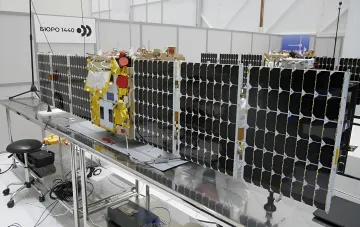
Russia has successfully launched the second batch of satellites for the 'Rasvet' system into orbit. This was reported by Serhiy Beskrestnov, an advisor to the President of Ukraine on technological development in the defense sector, known in the media under the pseudonym 'Flash'.
According to the Ukrainian expert, whose data was published in his Telegram channel and republished by RBK-Ukraine, the launch of the second batch confirms the active phase of deploying the Russian satellite constellation. Currently, up to 40 units of this system are in orbit.
Goals and current status of the constellation
The 'Rasvet' system is positioned by Russian developers as a domestic analogue of the global satellite network Starlink. However, according to Beskrestnov, the launched satellites have not yet taken their target positions in the orbital constellation. The expert notes that the process of placing the units into working orbits may be completed in the near future.
For the system to function fully for military purposes, according to Zelensky's advisor, Russia will need to significantly expand the scale of launches. "To begin using the 'Rasvet' constellation for military purposes, Russia will have to launch at least several hundred satellites," emphasized Beskrestnov.
Context of technological escalation
The announcement of the satellite launch became part of a series of warnings from the Ukrainian side regarding the development of the adversary's military technologies. Previously, Serhiy Beskrestnov drew attention to changes in the tactics of using unmanned aerial vehicles.
In particular, he noted that Russian operators are increasingly using 'Shahed' kamikaze drones in manual control mode, which increases their effectiveness and makes them harder to intercept. Furthermore, it became known that the adversary has created 'smart' drone swarms capable of acting in a coordinated manner.
In a separate comment, the President's advisor also explained the reasons for delays in the activation of ballistic threat warning systems, linking this to the technical specifics of monitoring systems and trajectory analysis.
Thus, the launch of the second batch of 'Rasvet' satellites indicates the continuation of a large-scale program to create Russian space infrastructure, which in the future may be integrated into the military management and communications system.