
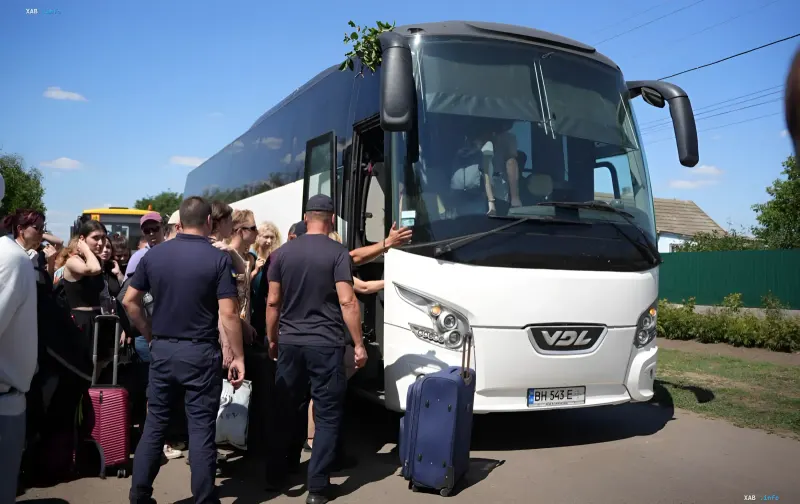
On August 13, 2026, a tragedy occurred in the Odesa region, marking the second incident involving passenger transport in the area within a single day. Russian forces struck a moving train in the Berezivka district. The attack caused the locomotive and surrounding dry vegetation to catch fire. The situation required immediate intervention by rescue services to evacuate hundreds of passengers.
Massive evacuation and rescue operations
According to the State Emergency Service (SES) of the Odesa region, 525 people were evacuated from the burning train. Among those evacuated were 130 children. To ensure the safety of passengers and their rapid transport to safe zones, 17 evacuation buses were deployed. The vehicles were provided by both the SES and local city authorities. The fire, which engulfed the locomotive and dry grass, was quickly extinguished by fire crews.
Series of attacks on transport infrastructure
This incident is the second strike on a passenger train in the Odesa region in the last 24 hours. Earlier that morning, on August 13, in the same Berezivka district, a Russian Shahed drone attacked the locomotive of another passenger train. That strike hit the driver's cab directly, resulting in the deaths of the engineer and his assistant. 340 passengers, including 67 children, were evacuated from that train. A repeat attack on a similar section of the track indicates targeted pressure on the region's railway logistics.
Situation assessment by Ukrzaliznytsia leadership
Alexander Pertsovsky, Chairman of the Board of Ukrzaliznytsia, confirmed the attack, noting that it occurred on a section similar to the location of the morning incident. This suggests that the enemy is using a tactic of repeated strikes on vulnerable points of railway tracks in an attempt to disrupt passenger transport. Company officials continue to gather information on the state of the infrastructure and possible track damage, but the primary task remains ensuring human safety.
Contradictory data
Currently, there are discrepancies regarding the exact time and type of weapon used in the second attack. While the SES confirms the fire on the locomotive and dry grass, as well as the scale of the evacuation, official data on the specific type of munition used in the second attack has not yet been released. Some sources suggest the possible use of unmanned aerial vehicles similar to the morning attack, but this requires further confirmation from security agencies. The exact number of casualties, beyond the fact that there are injured persons including a child, is being clarified during the medical examination of the evacuees.