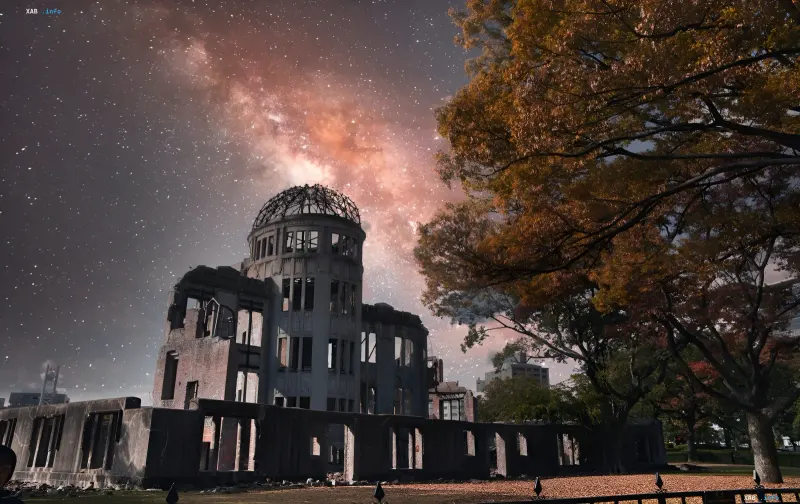
The history of the atomic bombing of Hiroshima, which took place on August 6, 1945, has been studied in depth by historians and physicists. However, even almost 80 years after the tragedy, the ruins of the city continue to hold secrets. A group of researchers made an unexpected discovery while analyzing microscopic traces of the explosion: a new type of alloy was found, which formed under the extreme conditions of a nuclear blast and had remained unnoticed by science until now.
RBC-Ukraine reports this based on a study published in the prestigious journal Science Advances.
The Birth of a New Substance in Hell
The atomic bomb explosion over Hiroshima created conditions unattainable in laboratories. A fireball with a temperature exceeding 7,000 degrees Celsius instantly turned the surrounding environment — buildings, soil, metal, and glass — into a chaotic plasma vortex. In this process, hot metal droplets were formed, which scattered across the city and settled in the environment. Scientists have named these formations "hiroshimaites".
A team of researchers led by geologist and crystalloger Luca Bindi from the University of Florence undertook a detailed analysis of these microscopic samples. After studying 34 samples using microscopy, chemical analysis, and X-ray diffraction, the team made a sensational announcement.
"We discovered a previously unknown, silicon-rich multi-component alloy inside a microscopic sphere formed during the atomic explosion in Hiroshima," Luca Bindi said.
Unique Structure in a Microscopic Grain
The size of the discovered particles is about 10 micrometers — slightly larger than a human red blood cell. However, inside this tiny sphere, scientists found an amazingly ordered atomic structure. The alloy consists of iron, nickel, silicon, and aluminum. All these elements came from vaporized buildings and structures located in the epicenter of the explosion.
This discovery proves that nuclear explosions do not just melt or deform existing materials. They are capable of creating complex, highly ordered crystalline alloys that cannot be obtained through ordinary melting.
"This indicates that extreme conditions with rapid cooling allow for the systematic investigation of unusual areas of structure and chemical state of matter," Bindi added.
Differences from the Trinity Test
An important aspect of the study was the comparative characterization with the first nuclear device test at Trinity. Scientists note that the bomb in Hiroshima was detonated at a much greater height. This fundamentally changed the physical conditions of crystal formation, leading to the appearance of a unique alloy that was not recorded in other cases.
Significance for Science and Forensics
The microscopic compounds found in Hiroshima effectively captured the details of an explosion that lasted only a few seconds. From the point of view of nuclear forensics, such crystals contain invaluable diagnostic data about the device materials, the environment, and the thermochemical conditions during detonation.
Furthermore, such multi-component alloys usually possess exceptional mechanical strength, as well as thermal and corrosion resistance. Scientists are convinced that studying such extreme events under controlled conditions will help better understand not only historical facts but also unknown chemical processes in nature, opening new horizons for materials science.