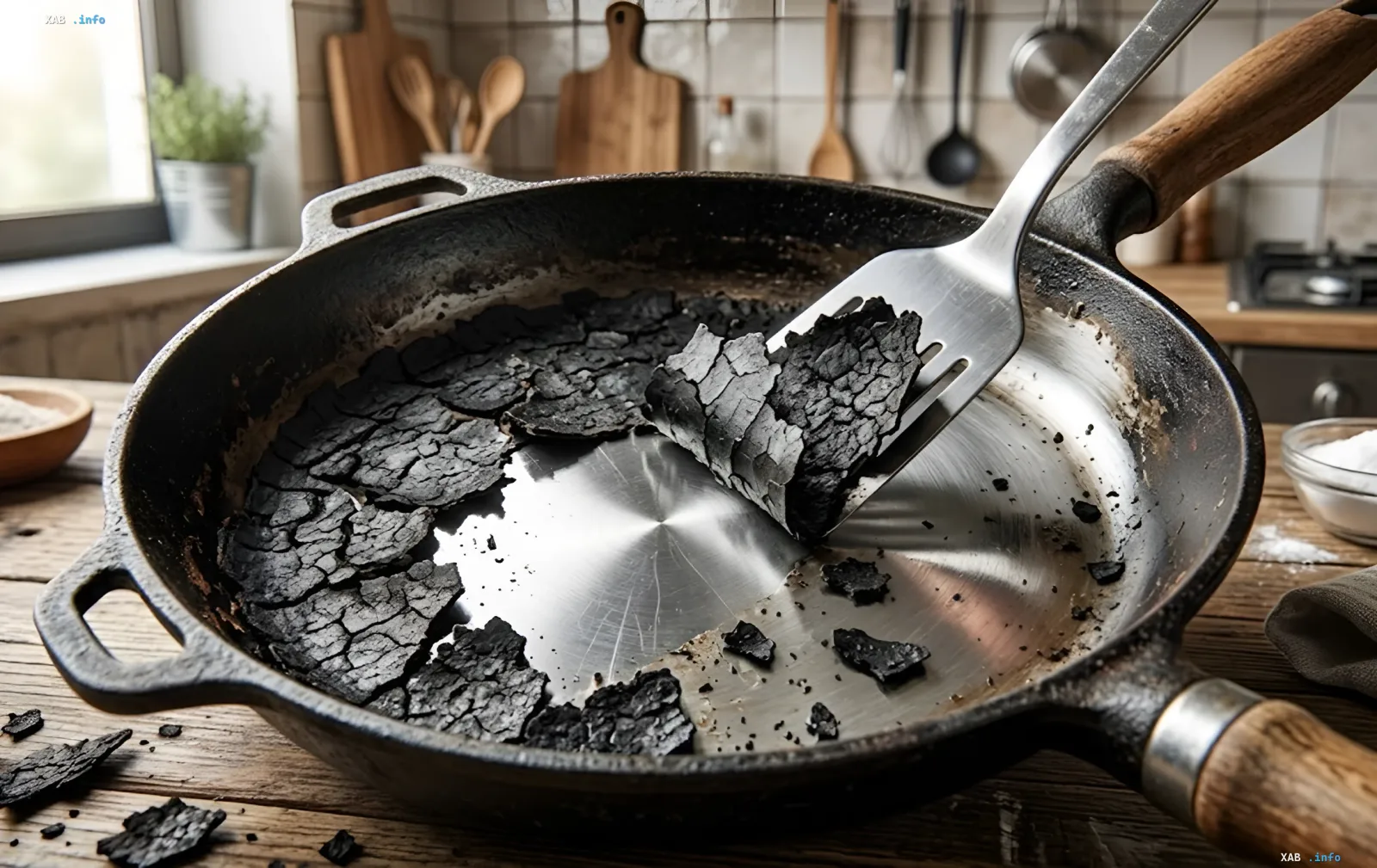
In the modern kitchen, where cooking speed becomes increasingly important, the condition of cookware plays a critical role. Even the most expensive and high-quality pan will eventually be covered with a stubborn layer of grease and burnt-on residue. Most often, this "shell" concentrates on the outside of the bottom, where fat is constantly in contact with an open flame or heating element. Ordinary detergents and soft sponges cannot handle this task, while using hard metal scrapers requires titanic effort and carries the risk of damaging the surface. However, according to the latest data from the Styler editorial team, there is a method that allows you to restore cookware to its original appearance in just a few minutes.
Chemistry in your kitchen: the principle of action
The secret lies in using the right combination of simple, accessible ingredients that create a powerful chemical reaction. This reaction literally loosens hardened years-old fat, allowing it to be removed in one motion. The method is based on the interaction of an alkaline environment (baking soda) and acid (table vinegar). When in contact with water and heat (if the pan is still warm), active carbon dioxide is released, which mechanically destroys the structure of the burnt-on residue, penetrating into micro-cracks.
Step-by-step instructions for removing burnt-on residue
The cleaning procedure is simple and does not require specialized equipment. First, you need to turn the dirty pan upside down, as burnt-on residue most often forms on the outside, and place it on a flat surface or in the sink. Next, generously and evenly sprinkle the dirty bottom with baking soda, and then add a layer of table salt on top. These components will act as a mild abrasive and solvent, enhancing the cleaning effect.
The next stage is preparing the "compress." Tightly cover the bottom of the pan with ordinary paper towels (it is better to use 2–3 layers) so that they completely cover the area with burnt-on residue. Then generously pour table vinegar over the paper towels. You will immediately hear a characteristic hissing sound and see foam formation — this is the alkali reacting with the acid. Leave the pan in this state for exactly 15–20 minutes. During this time, the mixture will break down the hard fat crust. After the time has elapsed, you only need to peel off the soaked paper towels — you will see how they remove most of the dirt with them. The remaining softened burnt-on residue is easily washed away with warm water using an ordinary kitchen sponge.
Important nuances for different types of cookware
This method is ideal for the outside of any frying pans, as well as for cast iron and steel cookware without coating. However, if you need to clean the inner surface of a delicate Teflon (non-stick) pan, categorically refuse to use salt. Salt crystals can scratch the sensitive layer, so in this case, limit yourself to only baking soda, detergent, and vinegar, excluding the abrasive effect.
Contradictory data
While the method with soda and vinegar is considered one of the safest and most effective, there are disagreements in the expert community and among users regarding alternative means. For example, some sources, such as Unian, recommend using Coca-Cola and toothpaste to remove burnt-on residue. Coca-Cola contains orthophosphoric acid, which indeed effectively eats away burnt-on residue, however, its high acidity and sugar content can leave a sticky film requiring thorough rinsing, making the process less eco-friendly compared to soda. Other sources, including Ura-Inform, suggest using special gels for cleaning ovens, which are undoubtedly effective but contain aggressive chemicals requiring the use of gloves and room ventilation.
Economic efficiency and eco-friendliness
Using the above-described method with soda and vinegar is not only effective but also economically beneficial. The cost of ingredients is minimal, and their availability in any grocery store makes this lifehack a universal solution for any housewife. Moreover, the method is environmentally safe, as it does not require the use of aggressive chemicals that can enter the sewage system. This is especially relevant in the context of growing attention to ecology and sustainable development in 2026.