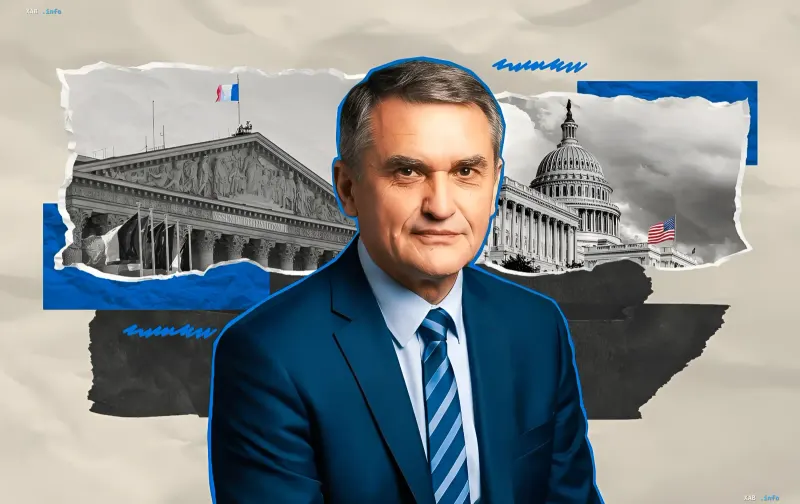
Ahead of the US midterm elections and against the backdrop of a deep political crisis in France, Oleh Shamshur — Ambassador Extraordinary and Plenipotentiary of Ukraine to the US (2005–2010) and to France (2014–2020) — gave an exclusive interview to RBC-Ukraine's "Do Not Interrupt!" project. In an abridged version of the conversation, he assessed what will change in Washington after November 3, how realistic the scenario of Donald Trump's impeachment is, and what consequences Marine Le Pen potentially coming to power in France might have for supporting Ukraine.
What Will Change in Washington After November 3
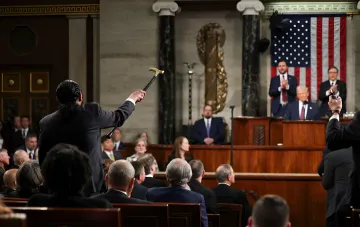
According to Shamshur, sociologists predict a Democratic victory in the House of Representatives with a "relatively stable majority, not on a knife's edge," while a Senate scenario is also possible, although forecasts for it are more cautious. If Democrats win the House, the interviewee assesses, this means the end of Trump's attempts to implement his legislative program: the opposition will launch investigations and hearings. Trump himself, Shamshur notes, "understands this perfectly" and is doing everything possible to minimize the Democratic victory.
Why Trump's Impeachment is Unrealistic
The impeachment scenario, in the former ambassador's estimation, is "completely unrealistic" and "out of the realm of nightmares." A simple majority is enough to launch it in the House of Representatives, but two-thirds of the votes are required in the Senate, which the Democrats will not have "under any scenario." Therefore, as Shamshur puts it, this would be "pure political theater," on which Democrats are unlikely to want to spend political capital, much like what happened before the 2024 elections.
Aid to Ukraine and the Concept of the "Imperial Presidency"
Shamshur calls the president the central figure in shaping US foreign policy, so in foreign policy "we will not see radical changes." In domestic policy, everything will depend on whether Trump is willing to reckon with realities; there is a theory that he will behave even more aggressively, proving that "Congress is not his boss." Regarding aid to Ukraine and sanctions: even if Congress allocates funds or passes a sanctions bill, Trump, according to the interviewee, relies on the concept of the "imperial presidency" and believes he has the right to use this money or not. Shamshur points out that sabotage or delays in implementing decisions under the pretext of "peace talks" with Russia have already been observed. Sensible changes, in his estimation, are more likely possible in January 2029 — unless a successor of the same orientation comes to power, while the remaining two years will be "very difficult" for Ukraine.
Who Will Lead the Democrats in Two Years
There is currently no single unambiguous leader in the Democratic Party — it is, in Shamshur's phrase, "a vinaigrette of candidates." Among prominent figures, he names a group of strong governors (in particular, California Governor Newsom), does not rule out the possible nomination of Kamala Harris, although he treats her "very critically as a politician," and draws attention to new faces — for example, Senator Ossoff from Georgia. Separate anxiety, he says, is caused by the strengthening of the far-left wing (Alexandria Ocasio-Cortez, Bernie Sanders): if this faction in Congress is large, it may promote the thesis that one must think about ordinary Americans rather than aid to Ukraine, which will further complicate the situation. Overall, Shamshur emphasizes, the processes in both parties indicate a systemic crisis of the US two-party system.
The French Factor and the Le Pen Risk for Kyiv
A separate block of the interview is devoted to France, where, according to Shamshur, Marine Le Pen could win, and this could block aid to Ukraine. That is why, as he puts it, Kyiv should already be seeking approaches to the French far-right. Thus, the combination of the outcome of the US midterm elections and a potential change of power in France creates, according to the interviewee, new challenges for global security and support for Ukraine.