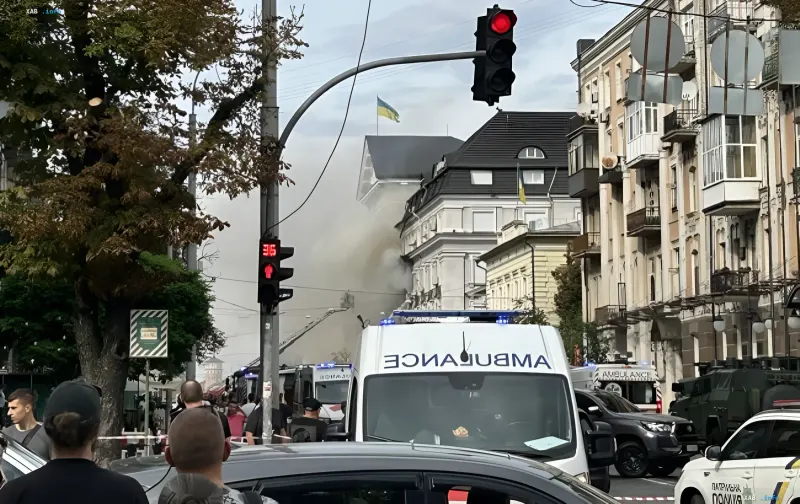
On September 4, 2026, the Russian armed forces carried out a strike on the building of the Security Service of Ukraine (SBU), located in the central part of Kyiv. According to Ukrainian authorities, the attack, carried out using a Shahed-type unmanned aerial vehicle, damaged the SBU building, which is situated in the immediate vicinity of the consular section of the Embassy of the Slovak Republic. A thick column of smoke rises from the building, and emergency services are working at the scene: footage from the site shows ambulances, fire crews, and military vehicles. The Ukrainian Foreign Ministry classified the incident as a serious escalation and evidence of Moscow's complete abandonment of the diplomatic track for resolving the conflict.
Bratislava's Diplomatic Reaction
The Minister of Foreign and European Affairs of Slovakia, Júraj Blahar, issued a resolute statement in which he condemned Russia's actions and called for adherence to safety measures. "I have ordered the Russian ambassador to the Slovak Republic to be summoned," the head of the Slovak Foreign Ministry announced, RBC-Ukraine reports, citing an official statement by the Ministry of Foreign Affairs of the Slovak Republic. Blahar emphasized that the consular section premises in Kyiv are used in a limited mode for security reasons, and that no one was in the building at the time of the enemy strike. Nevertheless, Bratislava's diplomatic department deemed it necessary to react publicly to the incident, which in itself is an unusual step for Slovak foreign policy.
Call for Restraint and Condemnation of Escalation
In his address, Júraj Blahar formulated a two-sided appeal: "We call on Russia to refrain from actions that may endanger the life and safety of civilians. At the same time, we appeal to both sides to avoid further escalation that increases tensions and does not contribute to a peaceful settlement of the conflict." Thus, Bratislava, while maintaining a formally neutral tone, effectively placed responsibility for the direct threat on the Russian side, while simultaneously calling for mutual restraint. The Slovak Foreign Ministry also demanded that Moscow provide explanations on the circumstances of the incident, which, according to Ukrainian observers, is one of the few hardline diplomatic responses from Bratislava to Russia's actions in the current conflict.
Kyiv's Position: A "Painful Response" and the Question of Strike Correction
The Security Service of Ukraine, whose building became the target of the attack, stated that the response to the "brazen aerial attack" will be "painful for the enemy." Ukrainian authorities emphasize that a strike on an intelligence service facility in the center of the capital, in the immediate vicinity of a diplomatic mission, goes beyond standard tactics and indicates a deliberate increase in the level of risk for the civilian population and diplomatic missions. In addition, open sources contain speculation that the Shahed attack on the SBU building may have been corrected by a Russian agent directly from the scene via online control. This claim has not been officially confirmed by either side as of publication and remains a working hypothesis.
Contradictory Data
The core body of facts — the fact of the strike on the SBU building itself, the absence of people in the consular premises at the time of the attack, and the Slovak minister's statement about summoning the Russian ambassador — is confirmed by both Ukrainian and Slovak official sources. However, a number of details remain inconsistent or unconfirmed. First, the claim that a Russian agent corrected the UAV's flight from the scene is put forward in the form of a supposition ("it is believed that he may have corrected it") and is not supported by any debris analysis, testimony, or official statement by the SBU or the Main Investigative Bureau. Second, the Slovak Foreign Ministry's statement does not disclose what specific "explanations" are required from the Russian ambassador or by what deadline a response is expected, leaving room for interpretation of the depth of the diplomatic pressure. Finally, footage from the scene shows elements that may indicate significant structural damage, however, neither Ukrainian nor Slovak officials, as of publication, have provided precise data on the scale of the damage or the presence of casualties.
Context: Why Slovakia's Reaction Is Unusual
The Slovak Republic has maintained a restrained diplomatic line throughout the conflict and has extremely rarely issued direct public condemnation of Russian strikes on Ukrainian infrastructure. Bratislava's current reaction — public condemnation, summoning the ambassador, a call for restraint — stands out against the general backdrop and, according to Ukrainian analysts, may indicate a reassessment of Slovakia's position in light of the direct threat to the country's diplomatic mission in Kyiv. The September 4 incident, therefore, became not only a military but also a diplomatic turning point, which will be closely watched both in Brussels and in Moscow.