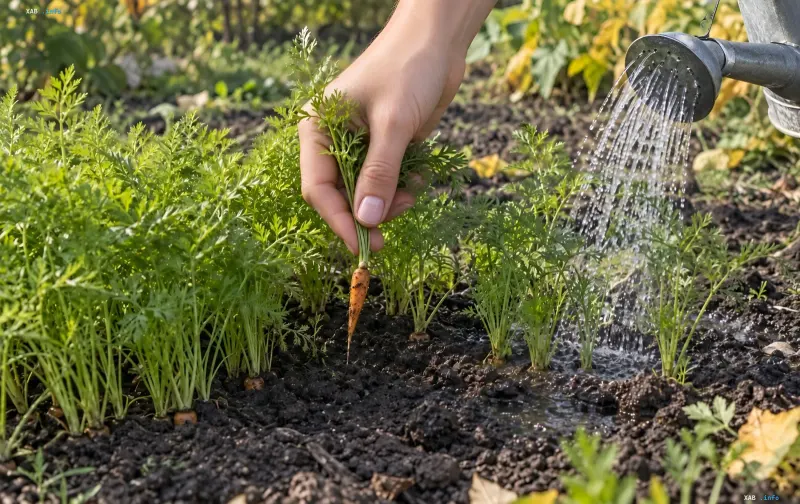
If your carrots in the bed are still thin and small in September, it is not a death sentence for the harvest. According to data from the Styler project (RBC-Ukraine), root vegetables that have not reached varietal maturity continue to "fill out" during this time of year as well. The final size depends on the sowing date, the variety, the weather, and the condition of the bed, so the gardener's task right now is not to panic or to feed the plants "just in case," but to check two basic things: whether the carrots are getting enough moisture and whether they are sown too densely.
Moisture: less often, but more abundantly
Root vegetables need a sufficient amount of water for normal growth. Specialists from the Royal Horticultural Society of the UK (RHS) note that carrots are generally drought-tolerant, however, during periods of prolonged drought they require good watering so that growth does not stop. At the same time, it is important not to moisten the soil a little every day: if the ground dries out and is then suddenly flooded, the roots can crack. In dry weather, it is better to water the bed less often but abundantly, so that the water reaches the root zone.
Thinning: space is what matters
If the carrots are sown too densely, the roots simply do not have enough room: the plants compete for water, light, and nutrients. The RHS recommends thinning carrots to about 5–7 cm between plants, and the University of Minnesota emphasizes that adequate spacing reduces competition and helps the roots develop normally. If the carrots in the bed are growing literally "like a wall," the extra plants should be carefully removed — this is especially relevant for plots where the roots are very thin.
Fertilizers are not the main factor
The small size of the carrots does not mean they urgently need additional feeding. The size of the root is determined not only by nutrition, but also by the variety, the sowing date, the density of planting, the humidity, and the soil condition. Therefore, in September it is more sensible to fix the obvious problems with watering and overcrowding rather than experimenting with large doses of fertilizers, which can harm the quality of the harvest.
Realistic expectations
It is important to understand: if the carrots were sown late or their development is significantly behind, they will not necessarily turn into large roots within a few weeks. But if the plants are still actively growing and there is enough moisture and space, the extra time in the bed can benefit the harvest. Thus, September is not a time for radical measures, but a period of targeted adjustment of watering and planting density.