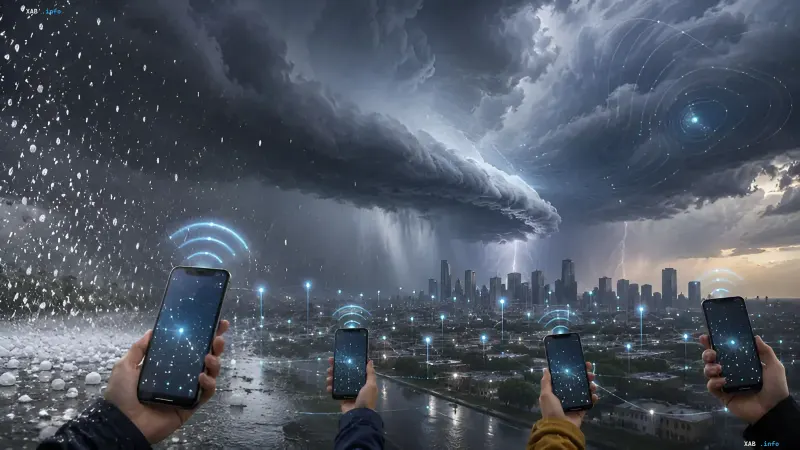
In the context of rapid climate change and the increasing frequency of extreme weather events, such as sudden thunderstorms and hail, forecast accuracy becomes critical for public safety and agriculture. Traditional weather stations, despite their reliability, often fail to meet the need for detailed tracking of small-scale atmospheric processes due to their low density. However, a new study conducted by scientists from Peking University offers an innovative solution: using millions of smartphones as a distributed sensor network to monitor atmospheric pressure.
Data Collection Technology: From Barometers to WRF Models
A study conducted in 2021 demonstrated that barometers built into smartphones are capable of recording changes in atmospheric pressure with high accuracy, allowing for the identification of small-scale structures of thunderstorm fronts. Scientists used anonymous data collected via the Moji Weather app with user consent and integrated it into the WRF (Weather Research and Forecasting) numerical model. Machine learning algorithms were used to correct errors, which improved forecast accuracy.
Experiment Results: 14–17% Improvement in Forecast Accuracy
During the experiment, researchers compared several modeling scenarios: without smartphone data, with data from traditional weather stations, and with smartphone data using two different error correction methods. The results showed that using smartphone data improved the accuracy of the hailfall zone forecast by 14–17% compared to the control modeling. Furthermore, smartphones allowed for a more accurate reproduction of the contours and dynamics of thunderstorm air masses, which is particularly important for warning about sudden weather events.
Contradictory Data: Technology Limitations
Despite impressive results, the technology of using smartphones as weather stations has its limitations. The main drawback is the uneven distribution of data: there are many smartphones in densely populated areas, but few in mountains, rural areas, and other sparsely populated regions. In the studied case, the thunderstorm formed over mountains where smartphone density was low, which prevented the complete correction of modeling errors at the early stage of storm development. This highlights the need for further improvement of the technology and expansion of the sensor network.
Development Prospects: Integration with Traditional Weather Stations
While smartphones cannot completely replace traditional weather stations, they represent a valuable addition to existing weather monitoring systems. Integrating data from smartphones and weather stations can create a denser and more accurate sensor network capable of tracking weather phenomena in real time. In the future, this could lead to the creation of a global thunderstorm and hail warning system that uses data from millions of devices worldwide.
Conclusion: A Step Towards More Accurate Forecasts
The research by scientists from Peking University demonstrates the huge potential of using smartphones in meteorology. Although the technology is still in the development stage, it has already shown significant improvements in forecast accuracy. In the context of the growing number of extreme weather events, such as thunderstorms and hail, the use of smartphone data can become an important tool for protecting the population and agriculture. Further research and development of this technology promise even more accurate and reliable weather forecasts in the future.