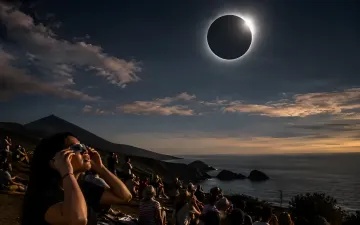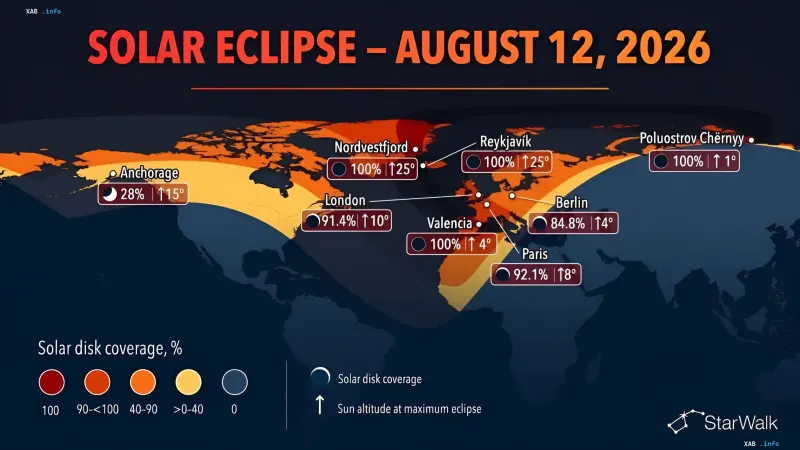
On August 12, 2026, Europe will witness a rare astronomical event — a total solar eclipse, which for the first time since 1999 will cover the continental part of Europe. This phenomenon is generating widespread interest among astronomers, scientists, and astronomy enthusiasts worldwide. The path of the Moon's total shadow, approximately 294 kilometers wide, will cross the North Atlantic and the Iberian Peninsula, affecting Greenland, Iceland, and northern regions of Spain. In Ukraine, the astronomical phenomenon will be visible exclusively in its partial phase, with the minimum percentage of coverage in central areas and the maximum in the west.
Astronomical Parameters and Geographic Visibility
According to data from the National Aeronautics and Space Administration (NASA) and the specialized service Timeanddate, viewing conditions for the eclipse in Ukraine vary depending on geographic coordinates. In western regions, such as Uzhhorod, the degree of solar disk coverage reaches 43.4% with a peak phase at 20:47, while in Lviv it is 40.5% with a peak at 20:43. In the Volyn and Rivne regions, phase indicators range from 30% to 35%. In Kyiv and central regions, the astronomical event has an extremely low degree of visibility — the Moon covers about 2.7% of the Sun's area. Observation is possible during a short time interval from 20:14 to 20:23 Kyiv time, immediately before the setting of the celestial body.
Safety Standards and Technical Regulations for Observation
International ophthalmology institutes and specialized astronomical services emphasize the need for strict adherence to safety techniques when directly visualizing the solar disk. Direct observation without protection or using makeshift light filters (darkened glass, photographic film, X-rays) is prohibited, as it leads to thermal damage to the retina (solar retinopathy). To record the phenomenon, only specialized equipment is permitted: optical filters standardized to ISO 12312-2, aperture solar filters, and the method of indirect projection through a pinhole (camera obscura) or projection system without looking directly at the Sun.
Contradictory Data
While astronomical services provide accurate data on the visibility of the eclipse in various regions, there are discrepancies in assessments of the event's impact on Europe's energy systems. Some sources indicate a possible loss of 10 GW of energy during the eclipse, which could lead to power supply failures. Other experts believe that modern technologies and preparatory measures will allow these risks to be minimized. Thus, the question of the real impact of the eclipse on energy systems remains a subject of discussion among specialists.
Humanitarian Aspects and International Cooperation
The solar eclipse on August 12, 2026, not only represents a unique astronomical phenomenon but also serves as an occasion for international cooperation and knowledge exchange. Scientists from different countries are joining forces to conduct research and educational programs aimed at raising public awareness about the safety of observing the eclipse. Humanitarian organizations are also using this moment to draw attention to issues of protecting the civilian population and ensuring access to safe methods of observing astronomical phenomena.