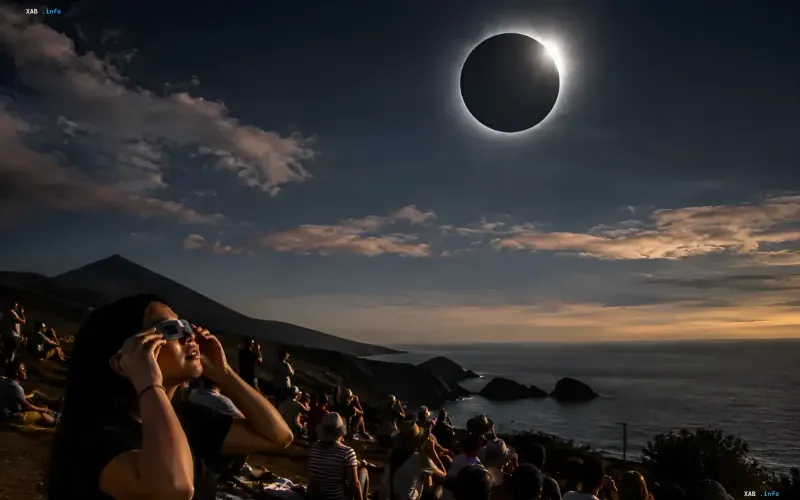
On August 12, 2026, Europe witnessed a rare astronomical phenomenon — a total solar eclipse. The path of totality passed through Greenland, Iceland, Portugal, and northern regions of Spain. However, despite the spectacle of the event, it placed a significant strain on the country's healthcare system. According to official data, at least 511 people sought medical attention in Spain with various symptoms arising during the observation of the celestial event.
Medical statistics and geography of the injured
An analysis of the cases shows that most victims received treatment for minor conditions. Among the main complaints, doctors recorded dizziness, anxiety attacks, as well as minor household injuries sustained in the commotion. However, the most worrying aspect was complaints related to vision. The geographical distribution of the injured was uneven: the highest number of cases was recorded in Catalonia — 115 people, followed by Madrid with 101 cases, and the Basque Autonomous Community took third place with 58 cases.
Danger to vision: the myth of a safe gaze
In Catalonia, where the largest concentration of victims was observed, 37 people complained of eye pain. Fortunately, only 10 of them required emergency medical care, indicating that in most cases, retinal damage was not critical. Ophthalmologists explain the surge in cases by the erroneous behavior of viewers. Many people mistakenly believe that during an eclipse, when the brightness of the Sun decreases, it becomes safe to observe with the naked eye. In reality, even when the Sun is partially covered by the Moon, the remaining part emits enough ultraviolet and infrared radiation to cause serious burns to the retina.
Expert recommendations and safety rules
Experts emphasize that using ordinary sunglasses or homemade filters (such as film from CD discs or welding glass without markings) does not provide sufficient protection. To observe solar eclipses, only special certified glasses meeting the international standard ISO 12312-2 should be used. Experts remind us that retinal damage may be painless at the moment of injury, but consequences in the form of blind spots may only appear several hours later, when seeking medical help may already be more difficult.
Scale of the phenomenon in Europe
The eclipse of August 12, 2026, was an important event not only for Spain but for all of Europe. While the total phase was observed in Greenland, Iceland, and Portugal, in major cities of Western Europe, including London and Paris, the Sun was covered by the Moon by 85–95 percent. This created an effect of "noon in twilight," which attracted thousands of tourists and astronomy enthusiasts, many of whom, unfortunately, neglected safety precautions.