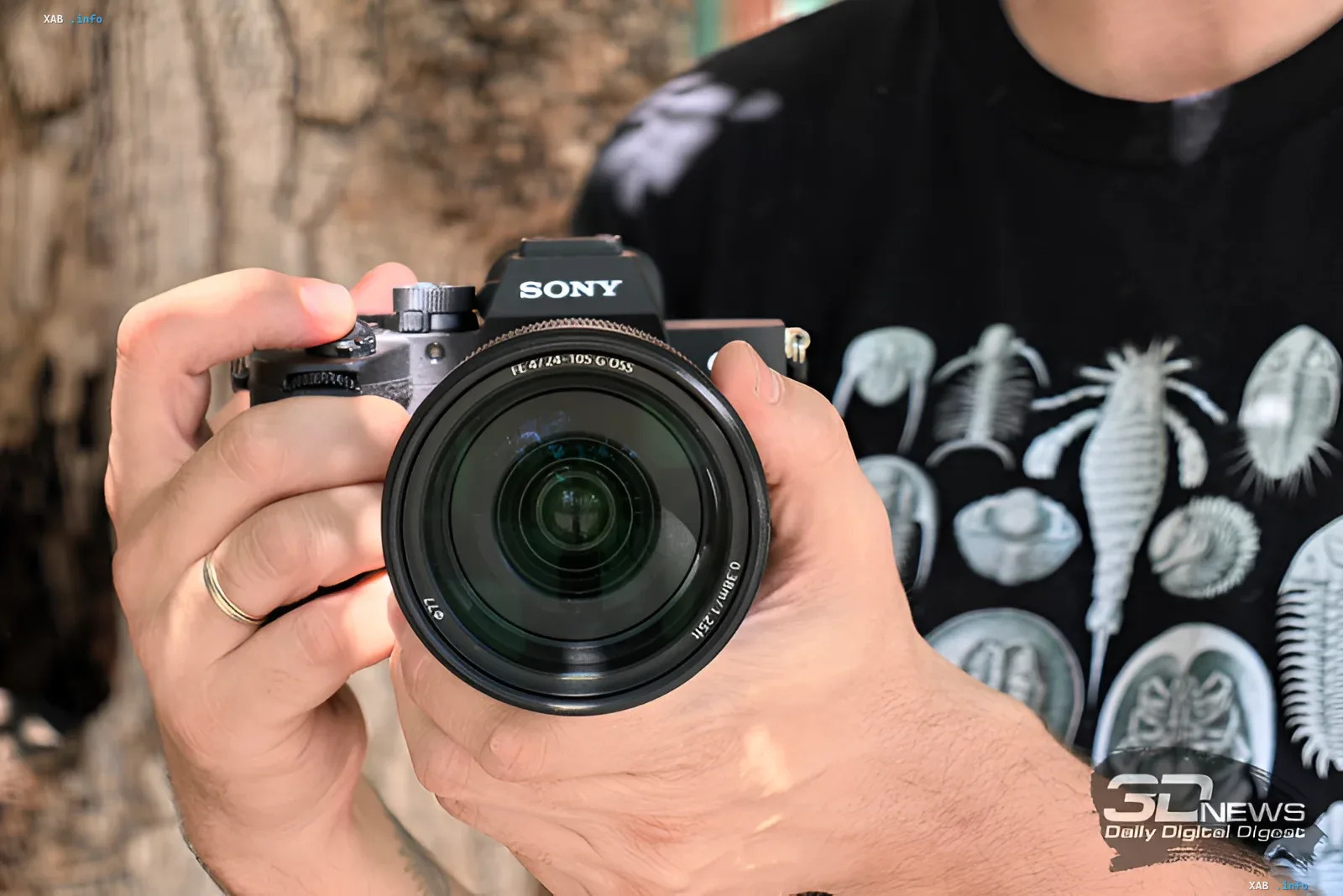
In the world of professional photography, four years used to seem like an eternity. But today, as the pace of technological development slows and the digital camera market narrows to a niche of specialized tools, such an interval has become the norm. The Sony a7 IV, released at the end of 2021, became a benchmark for many photographers, covering 90% of their tasks. And now, after a significant time, the company has presented its successor — the Sony a7 V.
At first glance, the new model looks almost identical to its predecessor, and key specifications, such as sensor resolution, remain unchanged. However, like its competitors (Canon R6 III, Nikon Z6 III, Panasonic S5 IIx), Sony decided not to reinvent the wheel but to address shortcomings and add missing features. It is in these details that the true revolution lies.
The Heart of the New Camera: Stacked Sensor
The main technical achievement of the Sony a7 V is the implementation of the partially stacked Exmor RS CMOS sensor. This is the first camera in the a7 line to feature such a construction. The practical significance of this innovation is hard to overestimate.
The signal readout speed from the sensor has increased by 4.5 times compared to the a7 IV. If the predecessor's figure was around 27 ms, the new model has reduced it to 15 ms. This is not just a marketing number — it is the readout speed that determines the absence of the "rolling shutter" effect during video recording, the speed of autofocus, and the smoothness of burst shooting. Now, when panning, vertical lines no longer "tilt".
Furthermore, the dynamic range has increased to 16 stops, which is one stop higher than the a7 IV. This promises more detailed shots in challenging lighting conditions.
Artificial Intelligence and Performance
The camera is equipped with the new BIONZ XR2 processor. Its key difference from the previous version is the built-in module for machine learning operations. Previously, a separate chip was used for AI functions; now everything is integrated, providing a speed boost and opening up new possibilities.
This is especially noticeable in stabilization performance. The 5-axis in-body image stabilization has become more effective: it now provides compensation of up to 7.5 stops in the center of the frame and 6.5 on the periphery (the a7 IV had 5.5 stops).
Burst shooting has seen a colossal speed increase. While the a7 IV could shoot a maximum of 10 frames per second, the a7 V delivers 30 frames per second with the electronic shutter. At the same time, the viewfinder does not black out — the photographer sees the subject in real-time, which is critical for reportage and sports. A pre-capture mode has also been added, allowing the buffering of images a second before the shutter button is pressed. This saves shots in situations where the photographer's reaction might be slightly slower than the event.
There is a compromise: the camera buffer has been reduced to 96 RAW or 185 JPEG images (the a7 IV had over 1000 frames). However, this is a conscious choice in favor of maximum operating speed.
Video: Full Frame and No Overheating
For videographers, the update is even more significant. The Sony a7 IV could only shoot 4K 60p with a 1.5x crop, effectively becoming a crop camera. The Sony a7 V records 4K 60p from the full width of the frame (oversampled from 7K), preserving the field of view of full-frame lenses and ensuring excellent detail.
The ability to shoot 4K video at 120 frames per second (with an APS-C crop) has been added, which is ideal for slow-motion. The cooling system has been redesigned, allowing the camera to work for 4 hours continuously without overheating.
For video, the Dynamic Active mode is also available — electronic stabilization with a ~1.65x crop, which works almost like a handheld gimbal stabilizer, smoothing out shake while walking.
What Was Left Behind?
Despite the progress, professionals may notice some limitations. RAW video is not recorded to the memory card due to the bandwidth limitations of SD UHS-II and CFexpress Type-A cards. The Open Gate mode (recording from the full sensor area) is also missing. However, for most users, the functionality of the new camera is more than sufficient.
Finally, data transfer to the smartphone has become faster and more stable thanks to the switch to the Wi-Fi 6 (802.11ax) standard and Bluetooth 5.3.