To mark the 35th anniversary of Ukraine's independence, the public organization Ukraine WOW, together with the National Museum of the History of Ukraine, reproduced one of the country's oldest bells — the bell of the Desyatynna Church, which laid the foundation of stone church building in Rus' at the end of the 10th century. Thanks to a combination of 3D scanning, X-ray fluorescence analysis, acoustic modeling, and casting at one of the world's leading bell foundries, a team of specialists from four countries not only recreated the artifact's shape but also restored its sound, which had not been heard for nearly eight centuries. The reconstructed toll sounded for the first time on 23 August 2026 at Ukraine's National Prayer Breakfast.
A relic discovered in 1937
Prince Volodymyr the Great founded the Desyatynna Church at the end of the 10th century. The temple became the first stone structure of its kind in Rus', and its bells called Kyiv's residents to worship and announced holidays, threats, and important events. In 1240, during the Mongol invasion, the church was destroyed and the bell was lost. A fragment of the artifact was only discovered in 1937 during archaeological excavations by the Ukrainian scholar Teodosiy Molchanovskyi (in some publications — Movchanovskyi). About 60% of the bell's surface has survived to this day, although the clapper and mounting elements did not. Since the find, the fragment has been kept in the collection of the National Museum of the History of Ukraine. The archaeologist's tragic fate — arrest on fabricated charges and execution in 1938 — became a separate part of the project's narrative: "Today his name sounds again together with this toll," noted museum director Yelena Zemniana.
From 3D scan to digital twin
In spring 2026, the surviving fragment became the basis for a full reconstruction. The first step was non-contact 3D scanning, which captured the geometry and all surface details of the original. Next, using X-ray fluorescence analysis, researchers determined the chemical composition of the bronze. Based on the data obtained, the shape of the surviving part, and historical analogues, a complete digital model of the bell was built. At the next stage, engineers carried out computer modeling: they calculated the metal's behavior on impact and modeled the propagation of sound vibrations. Acoustic synthesis allowed the team to hear an approximate rendering of the future bell's sound even before its physical manufacture.
An international team and German archives
The project brought together historians, archaeologists, engineers, acousticians, and casting masters from Ukraine, Germany, the Netherlands, and Portugal. German bell museums became a key source on clapper construction: the Westfälisches Glockenmuseum in Geseke provided materials on clappers from the 9th–13th centuries, and the GlockenStadtMuseum in Apolda — 3D scans of surviving clappers from the 13th–14th centuries. An additional reference artifact was a fragment of the crown of an ancient Russian bell from Sakhnovka in Cherkasy Oblast, also held in the National Museum of the History of Ukraine. The project's consultant was Portuguese bell expert Miguel Carvalho, who emphasized that the surviving fragment is an "extremely rare source of information on the shape, manufacturing technology, and metal of an ancient bell."
Casting in the Netherlands and the final result
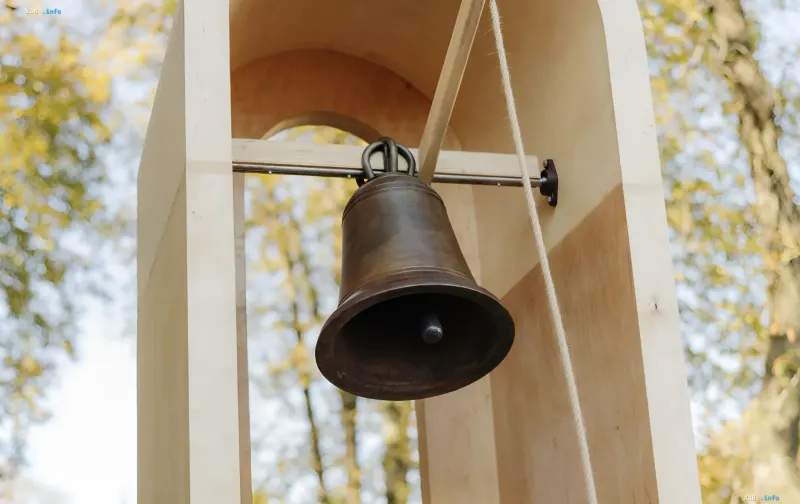
The final casting was carried out in the Netherlands at Royal Eijsbouts — one of the world's leading centers of bellmaking, where, among other things, bells were produced for Notre-Dame de Paris and other historic churches of Europe. The result was a reconstructed copy weighing 87.5 kg, whose alloy composition is as close as possible to the medieval original. According to Miguel Carvalho, the project's main value is the opportunity to restore a sound that the residents of medieval Kyiv could have heard: "This is the closest possible rendering of a sound that had been silent for nearly 800 years."
Contradictory data
The Ukraine WOW press release states that the project was carried out "without state funding, with the support of Kyivstar and Farmak." At the same time, the same message says that the work was done "with the support of the Ministry of Culture of Ukraine." The wording creates ambiguity: if the Ministry of Culture is a state body, then its "support" may be interpreted as institutional assistance (access to the artifact, expert support, a venue) rather than direct budgetary funding. However, no clear distinction between these types of support is given in the published materials. In addition, in the source text the name of the archaeologist who made the find appears in two spellings — "Molchanovskyi" and "Movchanovskyi" — which makes it impossible to definitively fix the correct surname without recourse to archival documents.
Presentation and miniatures
The reproduced sound of the bell was first presented to the public on 23 August 2026 during Ukraine's National Prayer Breakfast. In addition to the main reconstruction, the project team produced 20 miniatures of the bell, the further use of which is not fully disclosed in the provided materials. Ukraine WOW co-founders Yaroslava Hres' and Yulia Soloviev emphasized that the decision to recreate the bell "one-to-one — not only the shape but also the sound" was made after seeing the fragment in the museum collection and understanding its significance as a "testimony to the continuity of Ukrainian statehood."