Many still believe that the traditional Ukrainian costume and the customs associated with it disappeared at the beginning of the 20th century. However, archival photos taken in the 1950s–1970s shatter this stereotype. They depict not museum exhibits or staged scenes from folklore festivals, but real weddings in the villages of the Middle Dnipro region. And it is precisely these images that serve as proof that folk culture continued to live on even under the pressure of Soviet ideology.
What can be seen in the photographs?
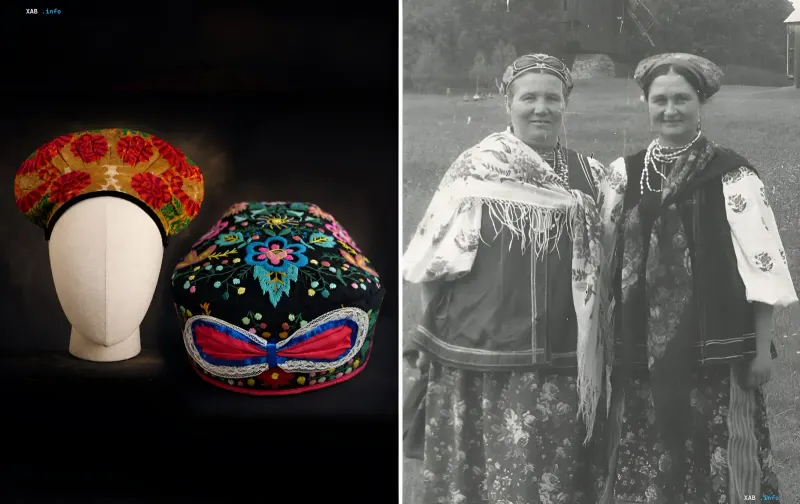
The photos show women in traditional Ukrainian attire: vyshyvankas (embroidered shirts), colorful skirts, and multi-strand necklaces. Particularly notable are the headdresses (chepets) worn over the head and scarves tied according to folk custom. This is not theatrical costume, but everyday clothing worn for important life events—especially weddings.
"For the older generation, this was not a theatrical costume or folklore, but a living continuation of family tradition inherited from their mothers and grandmothers," notes a message from the Telegram channel "All About Ukraine".
Two types of headdress: Poltava and Cherkasy
The photos reveal two regional variations of the chepetz—a headdress for married women:
- The Poltava "boat" headdress — elongated upwards, decorated with embroidery, resembling the shape of a boat.
- The Cherkasy headdress — rounded, densely covered with colorful flowers, often featuring bright decorative elements.
Both variations fit snugly on the head and are worn under a scarf, according to folk custom. The shape and finish depended on the region, but the essence remained unchanged: the headdress was a symbol of marriage and part of the cultural code.
Why is this important?
For decades, the Soviet authorities claimed that folk culture was a "survival of the past" that should be forgotten. But these photographs testify to the opposite: despite bans, pressure, and propaganda, women continued to wear headdresses at their children's weddings. The tradition did not disappear—it simply lived where it was not sought: in villages, at celebrations, and in the daily lives of ordinary people.
"These photographs are further proof that the authentic Ukrainian way of life was an integral part of our ancestors' lives not only a hundred years ago, but also in the second half of the 20th century," the message emphasizes.
Who published the material?
The material was prepared by the Styler project—a lifestyle and entertainment vertical of RBC-Ukraine that covers trends, celebrities, advice, recipes, and horoscopes. The project combines journalism with entertainment elements while maintaining a focus on cultural and social topics.
Photos, illustrations, and other images belong to their respective rights holders. The use of materials marked with the "Styler" logo or signed "Styler" or "RBC-Ukraine" is permitted under the Creative Commons Attribution 4.0 International license. When reproducing materials, an active hyperlink to styler.rbc.ua must be included.