A collision of asteroids in deep antiquity could have radically changed the course of the history of the Solar System. A new study published in The Planetary Science Journal shows that after the destruction of a large celestial body — asteroid Eulalia — Earth, the Moon, and Mars were subjected to prolonged bombardment by its fragments.
The cause of the catastrophe: resonance with Jupiter
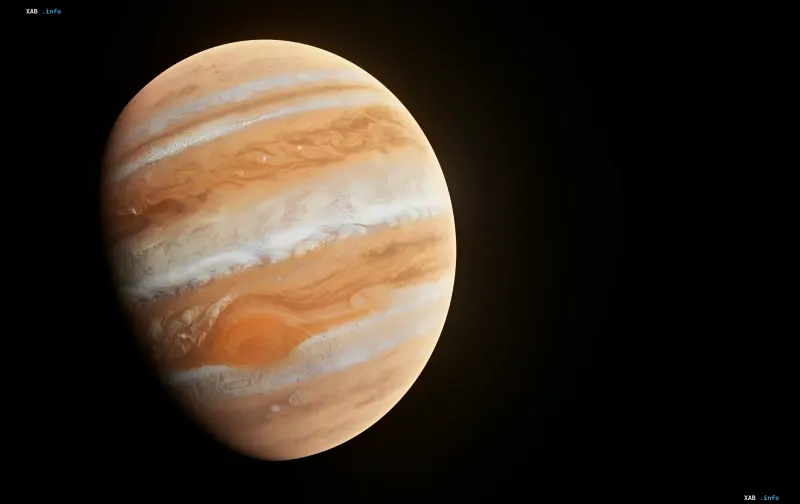
The key factor determining the trajectory of the fragments was the location of the parent asteroid. It broke up in close proximity to the orbital resonance zone with Jupiter (J3:1). In this region, the asteroid completes three orbits around the Sun for every one orbit of the gas giant, causing regular gravitational nudges from Jupiter.
It was precisely these nudges that acted as a "catapult," directing the fragments into the inner Solar System.
Two stages of bombardment
The study highlights two main stages of the impact of fragments on the terrestrial planets:
- Initial ejection: About 50% of the fragments of the shattered body entered the J3:1 resonance zone immediately after the collision. This caused a rapid and powerful surge in meteorite impacts on the surfaces of the Moon, Earth, and Mars.
- Secondary migration: The remaining 25% of fragments moved towards the resonance zone gradually, over 100–150 million years. This process was driven by the Yarkovsky effect — a weak reactive impulse arising from the uneven absorption and emission of solar heat by the asteroid's surface.
The lunar chronicle and terrestrial consequences
The link between the breakup of asteroid Eulalia and the impact flux that struck the planets 800 million years ago is confirmed by data collected by the Southwest Research Institute (Don Davis).
On Earth, geological evidence of events older than 650 million years has been practically erased by plate tectonics, volcanism, and erosion. However, the Moon, lacking active geology, has preserved a "chronicle" of cosmic cataclysms. Analysis of the age of lunar craters and samples of impact glass delivered by Apollo missions unequivocally points to a sharp increase in the number of large asteroid impacts precisely during this period.
Given Earth's larger size and stronger gravity, for every major impact on the Moon, there were about 20 similar or more powerful collisions with our planet.
Impact on the biosphere and geology of the planets
The peak of the bombardment coincided with a period of global cooling and significant changes in the Earth's biosphere. On Mars, these impacts triggered powerful seismic waves and coincided with a noticeable surge in volcanic activity.
Thus, the breakup of a single asteroid became a trigger for large-scale geological and climatic changes affecting three planets of the Solar System simultaneously.