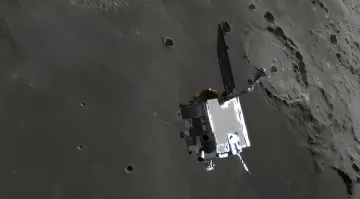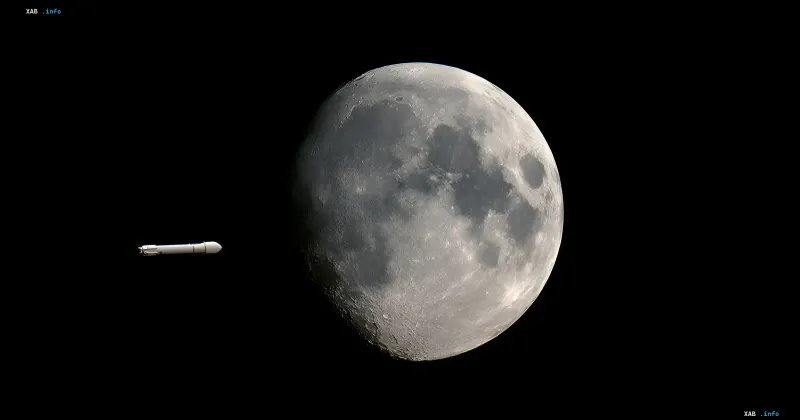
In August 2025, the Moon will witness a unique event that astronomers on Earth will be able to observe. The spent upper stage of SpaceX's Falcon 9 rocket is expected to collide with the surface of Earth's satellite. This will be the first time that the impact of a large artificial object on the Moon can be recorded in real-time using ground-based telescopes.
Destination and time of impact
The collision is scheduled for August 5. The estimated time of impact is 09:35 Moscow time. The impact site is located near the large lunar crater Einstein. Weather conditions and the observer's geographical location are critical for successfully observing the event: the flash will be best visible from South America and low-to-mid latitudes of North America, where it will be completely dark at the time of the event.
Flight history and trajectory calculation
The fate of this stage was decided earlier in the year. It belongs to the Blue Ghost mission, which launched on January 15, 2025. During this flight, Falcon 9 performed a dual task: delivering the Blue Ghost lunar lander from Firefly Aerospace and the Hakuto-R spacecraft from the Japanese company ispace to lunar orbit.
After the payloads were deployed, the stage ran out of fuel. Unable to maneuver or return to Earth, it was left drifting in space. The first person to calculate the trajectory and predict the inevitability of the collision was Bill Gray, creator of the Project Pluto planetary program. He entered flight data into his application, which allowed him to model the rocket's future path.
Object characteristics
The parameters of the falling object are impressive, but have their own features:
- The stage length is about 12 meters.
- The width is approximately 4 meters.
- The object mass is about 4000 kilograms.
- The impact speed on the lunar surface will reach 8700 km/h.
Scientific value of the event
Despite its impressive dimensions, the stage is a hollow shell, which distinguishes it from dense natural meteorites. According to scientific work by Gray and his colleagues, conducted using a physical simulator, the impact on the lunar surface will not be catastrophic. The object is moving "much slower" than natural impactors, so the scale of the crater will be limited.
Nevertheless, for the scientific community, this is a unique opportunity. Astronomers will be able to study in real-time the dynamics of dust and soil ejection during the collision. The data obtained will help better understand the behavior of the lunar surface during impacts and assess potential risks associated with space debris in lunar orbit.